
NHS Caffeine Policy: Trust Pulls Caffeinated Tea and Coffee from 10 Hospitals After Patient Falls Drop 35% — What It Means for the Caffeine Industry
NHS Caffeine Policy: Decaf-Default Across Ten Hospitals
In one of the most significant institutional caffeine policy shifts of the year, Derbyshire Community Health Services NHS Foundation Trust has formally moved patients to decaffeinated tea and coffee across ten hospital sites in the United Kingdom in a coordinated caffeine rollout that has been widely covered in U.K. health media and the broader caffeine industry press this week. The affected NHS facilities include Babington Hospital in Belper, Buxton Hospital, Cavendish Hospital, Clay Cross Hospital, Florence Nightingale Community Hospital in Derby, Ilkeston Community Hospital, Ripley Community Hospital, St Oswald’s Hospital in Ashbourne, Walton Hospital in Chesterfield, and Whitworth Hospital in Darley Dale. Patients can still request a caffeinated drink if they prefer, but decaf is now the default beverage offered on every ward as part of standard hospitality — a meaningful change for a healthcare system that previously served caffeinated tea and coffee routinely without consideration of clinical caffeine risk. The NHS caffeine decision was made at the trust board level following a formal review of clinical caffeine evidence, and the policy was implemented across all ten sites simultaneously rather than rolled out as a phased pilot, signaling a high level of institutional confidence in the underlying caffeine data and the trust’s assessment of the cost-benefit profile. Coverage of the NHS caffeine move has been notably extensive in U.K. health media this week, suggesting it may serve as a template for other NHS trusts considering similar caffeine interventions in the coming months as falls and patient safety remain top priorities.
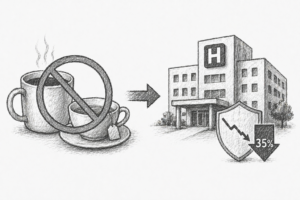
Caffeine Clinical Data: 35% Reduction in Patient Falls
The trust’s board papers describe caffeine as a central nervous system stimulant linked to a measurable cluster of adverse outcomes in inpatient settings: patient falls, disrupted sleep, blood pressure spikes, and heart palpitations that can be especially problematic in elderly inpatients and those on certain medications interacting with caffeine. Trial caffeine data cited by the trust — drawn from research conducted by Stow Healthcare and corroborated by parallel caffeine pilots at other NHS sites — showed a 34.72% reduction in patient falls and a 30% drop in continence-related fall incidents when caffeine was not routinely served on participating wards. The trust also flagged that consuming more than two cups of coffee or four cups of tea daily may raise the risk of bone fractures, citing caffeine’s effect on calcium absorption — a relevant clinical caffeine consideration for elderly inpatients already at elevated fracture risk and for whom even minor falls can cascade into prolonged hospitalizations. Beyond the immediate fall reduction caffeine data, the board papers also referenced sleep architecture improvements, reduced incidents of sudden cardiovascular fluctuation, and more stable blood pressure readings as secondary clinical caffeine benefits of the policy change, suggesting the trust expects compounding clinical benefits as the caffeine policy matures and as more patients move through the new default beverage protocol over the coming months and years of implementation. The data is a watershed moment for clinical caffeine policy.
Caffeine Policy Pattern: Spreading Across NHS and Beyond
Derbyshire is not alone in implementing this kind of clinical caffeine policy, and the broader NHS landscape suggests this approach is gaining institutional momentum across the U.K. healthcare system as more trusts review the caffeine evidence and weigh the operational implications. South Tees Hospitals NHS Foundation Trust ran a similar decaf-first caffeine pilot in 2025 across selected wards, with positive enough results to inform broader internal discussion about expansion, and The Rotherham NHS Foundation Trust launched its own Quality Improvement program to reduce patient falls and improve bladder health by switching wards to decaf as standard caffeine policy. With approximately 250,000 inpatient falls recorded annually in English NHS hospitals at an estimated cost of £2.3 billion per year, according to NICE figures cited in BMC Geriatrics caffeine research, the financial and clinical case for decaf-default care is becoming difficult for trust executives to ignore even when accounting for transition costs and patient communication challenges. The clinical caffeine pattern is also emerging in U.S. clinical literature, where caffeine’s interaction with antihypertensive medications, bladder function, and sleep quality is increasingly studied as a modifiable fall risk factor in geriatric inpatient settings. Cambridge University Hospitals also advises patients undergoing certain cardiac assessments to avoid tea and coffee on the morning of their appointment, citing caffeine’s effect on heart rate and blood pressure measurements — a quieter but significant signal of clinical caffeine caution that has existed in U.K. healthcare for years.
The NHS caffeine policy shift highlights an important nuance for healthy adult caffeine consumers thinking about their own caffeine habits in light of this kind of clinical caffeine evidence: the issue isn’t caffeine in principle, it’s uncontrolled, open-ended caffeine intake in vulnerable contexts where caffeine dose precision matters and where the consequences of getting caffeine wrong can include falls, fractures, and cardiovascular events that healthy adults rarely have to think about in their day-to-day lives. For non-hospitalized caffeine consumers, the implication is not to give up caffeine — it’s to know exactly what caffeine dose they’re consuming and when, and to recognize that the same biological mechanisms that make caffeine risky in clinical settings can produce milder versions of the same effects in healthy adults consuming variable, untracked caffeine doses across the day. Jiggle was designed with that nuance in mind from the beginning — 63 mg of natural plant-based caffeine per gummy, precisely dosed so caffeine consumers can tune intake to their actual physiology, activity level, hydration status, medication profile, and time of day rather than guessing at how strong a brewed cup or pot of coffee might actually be on any given morning. For corporate wellness programs, professional offices, eldercare-adjacent residential settings, and any environment where caffeine dose precision and accountability matter, a known-quantity natural caffeine format is fundamentally different from a pot of coffee that varies cup to cup. Learn more at jiggle.cafe.
Healthcare and Wellness: The Next Frontier for Plant-Based Caffeine
The takeaway for the broader caffeine industry is that healthcare and clinical wellness are becoming a meaningful and underexplored frontier for natural caffeine and functional caffeine product innovation, and the caffeine brands that engage with this opportunity early are likely to find first-mover advantages that will be difficult for late entrants to replicate once institutional purchasing relationships are established. Lower-dose, plant-based caffeine formats with predictable, measurable caffeine dosing are far better suited to clinical and high-precision environments than open-ended hot drinks brewed in break rooms or staff kitchens with inconsistent strength and unpredictable timing of caffeine consumption. The NHS caffeine shift is a leading indicator that hospitals, eldercare facilities, assisted living operators, rehabilitation centers, and corporate wellness programs in the U.S. will eventually face similar caffeine pressure as American clinical research catches up with U.K. evidence on falls, bladder health, and caffeine-medication interactions in vulnerable populations. The natural caffeine brands that build for those settings now — with formats, caffeine dosing protocols, and clinical-grade documentation that meet institutional procurement standards and pass clinical review processes — will define the institutional caffeine category as it emerges over the next five to ten years. This is fundamentally a B2B caffeine opportunity hiding inside what currently looks like a consumer caffeine story, and the operators who recognize it early and build the relationships, documentation, and product credentials required to enter institutional channels will have a meaningful and durable competitive advantage in the caffeine industry.