
Why Clean Caffeine Is the Smartest Productivity Investment: Liver Protection, Jitter-Free Focus, and the Death of Kitchen Hacks
Coffee’s Liver and Brain Protection Transform Caffeine from a Daily Habit into a Strategic Long-Term Productivity Asset
For professionals who rely on caffeine as a daily cognitive performance tool, today’s Earth.com report on caffeine’s ability to reduce liver scarring adds another dimension to the case for viewing moderate consumption as a long-term strategic investment rather than a short-term stimulant fix. The five documented mechanisms through which caffeine protects liver health, spanning antioxidant defense, anti-inflammatory action, antifibrotic activity, metabolic modulation, and microbiome balancing, operate in the background of every workday, protecting the organ systems that sustain professional performance over decades. Combined with recent studies documenting caffeine’s association with telomere lengthening equivalent to five years of biological youth and an 18 percent reduction in dementia risk, the evidence positions moderate caffeine consumption as one of the most cost-effective health interventions available to knowledge workers. The practical implication for productivity-focused professionals is that maintaining a consistent, moderate caffeine habit is not merely about staying alert during afternoon meetings. It is about protecting the cognitive infrastructure, the brain health, the metabolic function, the organ integrity, that underlies sustained professional performance across an entire career. The compound returns of daily organ protection over 20 to 30 years of professional life far exceed the immediate alertness benefit of any single cup of coffee.
The Salt-in-Coffee Debunking Reveals Why Real Solutions to Jitters Are Essential for Sustained Productivity
Today’s widespread Verywell Health coverage debunking the viral salt-in-coffee trend carries an important productivity lesson. The millions of consumers who searched for and tried this hack share a common pain point: they want caffeine’s cognitive benefits but are losing productive time and focus to the jitteriness, anxiety, and energy crashes that accompany overconsumption or sensitivity. Adding salt addresses none of these issues because the jitter mechanism is neurological, involving adenosine receptor blockade and catecholamine release, while salt operates only at the level of taste perception. For productivity-focused professionals, the relevant insight is that jitter-related productivity loss is a real and measurable problem that requires legitimate solutions, not viral hacks. Research has documented that caffeine-induced jitteriness reduces fine motor control, increases error rates in precision tasks, and impairs the kind of sustained, focused attention that knowledge work demands. The solution, according to dietitians, lies in managing total caffeine intake, optimizing consumption timing to avoid cortisol interference, ensuring adequate food intake before caffeinating, and selecting caffeine products formulated to minimize jitter-inducing properties. Products that combine caffeine with L-Theanine, or that deliver caffeine through slower absorption mechanisms, are specifically designed to address this productivity-relevant pain point.
Microplastic-Free Caffeine Delivery Eliminates a Hidden Productivity Drag That Most Professionals Have Never Considered
The Puresteel plastic-free coffee maker launch reported today by Inc. Magazine introduces a productivity consideration that few professionals have contemplated: the potential cognitive impact of daily microplastic exposure from conventional brewing equipment. While the acute effects of microplastic ingestion remain under active investigation, early research has linked chronic microplastic exposure to inflammation, a physiological state known to impair cognitive function, reduce working memory capacity, and slow processing speed. For professionals consuming three to four cups of coffee daily from plastic-component machines, the cumulative exposure over years could represent a meaningful, if currently unquantified, drag on cognitive performance. The Puresteel solution addresses this concern from the hardware side, but the broader productivity implication extends to how professionals think about their entire caffeine delivery system. Every component that touches hot water or brewed coffee is a potential contamination vector, from machine reservoirs and tubing to plastic-lined disposable cups and pod capsules. Professionals who have optimized their caffeine timing, dosing, and source selection for maximum cognitive benefit may find that addressing the hardware dimension represents the next frontier in caffeine-related productivity optimization.
Jiggle Gummies bypass the microplastic concern entirely while solving the jitter problem that the salt-in-coffee trend failed to address. Each gummy delivers an espresso-equivalent caffeine dose designed for sustained, jitter-free energy in seconds, without brewing equipment, without liquid volume that necessitates bathroom breaks during focused work sessions, and without the 20-to-30-minute consumption period that a cup of coffee requires. Learn more about Jiggle here https://jiggle.cafe/
Functional Caffeine Timing Combined with Clean Formats Represents the Leading Edge of Productivity Optimization in 2026
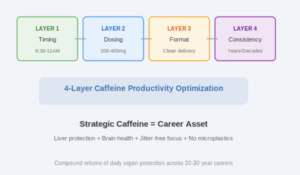
The convergence of today’s caffeine news, from liver protection science to jitter debunking to microplastic concerns to functional wellness launches, reveals that the most productive approach to caffeine in 2026 integrates multiple optimization layers. The first layer is timing: concentrating caffeine intake in the mid-morning window between 9:30 and 11:00 AM, after the body’s natural cortisol peak subsides, maximizes cognitive benefit while preserving sleep quality. The second layer is dosing: maintaining total daily intake between 200 and 400 milligrams captures the health-protective benefits documented in the liver, telomere, and dementia research without crossing into the overconsumption territory associated with jitters, anxiety, and tolerance escalation. The third layer is format: selecting caffeine products that deliver precise doses without sugar, excessive additives, or microplastic exposure risk ensures that the cognitive benefits are not offset by ingredient-related health costs. And the fourth layer is consistency: the long-term organ-protection benefits of caffeine accrue through sustained, moderate consumption over years and decades, not through occasional high-dose consumption. For professionals who integrate all four layers, caffeine becomes not just a daily performance tool but a strategic career asset that protects and enhances the cognitive capacity on which their livelihood depends.