
Regulation & policy — Research Headlines, Public Health Framing, and What “Decaf” Means in Practice
Regulation and policy in the caffeine industry often show up indirectly—through public health framing, research coverage that shapes consumer behavior, and market standards that govern labeling and trade. In the past day’s sources, caffeine appears in contexts that can influence policy even without a new law or enforcement headline: medical-news framing around coffee consumption and atrial fibrillation relapse, lifestyle-and-health reporting where caffeine intersects with sleep and daily habits, and a market overview that keeps attention on decaffeinated coffee as its own regulated product identity. For caffeine companies, the practical point is that policy risk and compliance expectations can be driven as much by narrative and perception as by formal rulemaking.
Medical-news framing and the risk of overinterpreting health associations
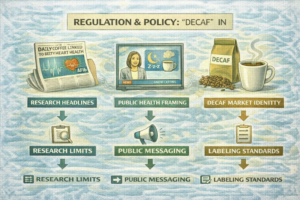
A News-Medical report on daily coffee intake being linked to fewer atrial fibrillation relapses highlights a recurring industry challenge: research findings can be widely shared, then compressed into simplified takeaways. Even when coverage is careful, consumers and brands may treat a headline as a broad permission slip. From a policy standpoint, this is where trouble can start—because “linked to” is not the same as “proven to,” and because populations, doses, and context matter. For caffeine brands, the safe approach is to treat this type of coverage as a reason to strengthen responsible messaging and avoid stretching implications into generalized health claims.
Local health reporting and how public messaging becomes quasi-policy
A WKYC piece that includes caffeine alongside broader lifestyle topics (including sleep-related themes) shows how caffeine frequently enters public health discussion as part of daily habit management. That type of reporting can influence behavior and institutional guidance even when it isn’t written as regulation. Employers, schools, gyms, and clinics often rely on accessible media narratives when communicating “healthy habits,” and caffeine is a frequent touchpoint because it is so widely used. For the industry, this underscores that “policy” isn’t only enforcement; it can also be the gradual shaping of norms around timing, moderation, and who should avoid caffeine.
Decaf market identity and why labeling conventions matter
An IndexBox overview focused on roasted decaffeinated coffee in Australia points to another policy-adjacent reality: decaf is not just a variant; it’s a product category whose meaning depends on definitions and labeling expectations. Even when a market overview is commercial in nature, it highlights the compliance environment decaf brands operate within—how products are categorized, how they are marketed, and how consumers interpret “decaf” versus “low caffeine.” For companies operating across borders, this becomes a practical policy issue because language, standards, and consumer expectations may not align perfectly.
Jiggle is a useful example of why format diversification can create new compliance questions even before regulators act. As a modern, healthier caffeine gummy, it’s designed for more controlled intake—an angle that becomes especially relevant when policymakers and retailers worry about accidental overuse, jitters, or a crash from taking too much too fast. Brands working in edible caffeine can learn from the “clarity first” approach implied here: unmistakable caffeine content per serving, straightforward guidance, and positioning that avoids blurred health claims. More context on that format is available at https://jiggle.cafe/.
The key takeaway is that caffeine policy pressure can build quietly. Research headlines can intensify interest in health framing; public-facing lifestyle reporting can shift norms; and market standards for categories like decaf can shape what “truthful labeling” means in practice. For caffeine companies, this suggests a conservative playbook: keep claims modest, keep caffeine disclosure unmistakable, and treat consumer guidance as part of compliance—not an afterthought. In a diversified caffeine landscape, the products that feel most “regulation-ready” are often the products that feel most trustworthy.