
Regulation & Policy: Iceland Survey Shows Overwhelming Public Support for Banning Energy Drink Sales to Minors Under 18
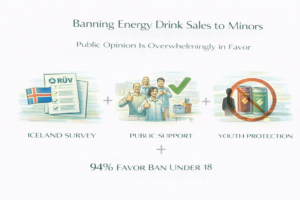
A survey highlighted in this week’s caffeine industry news from Iceland’s national broadcaster RUV reveals that a significant majority of the Icelandic public supports banning the sale of energy drinks to individuals under the age of 18. Iceland has long been at the forefront of caffeine regulation for young people, with existing laws already prohibiting the sale of the strongest energy drinks to anyone under 18. However, enforcement challenges persist, as high-caffeine products are often placed on retail shelves directly adjacent to energy drinks with more moderate caffeine levels, creating confusion for both consumers and cashiers. Professor Ingibjorg Gunnarsdottir of the University of Iceland has advocated for stricter measures, including potentially banning the sale of the highest-caffeine drinks altogether rather than relying on age verification at the point of sale. Research cited in the country’s risk assessment committee report indicates that caffeinated drink consumption among Icelandic young people in the 8th to 10th grades is among the highest in Europe, with conservative estimates showing intake levels up to twice as high as those of Norwegian youth. Approximately 30 percent of young Icelanders regularly consume caffeinated energy drinks, raising significant public health concerns about the long-term cardiovascular, neurological, and behavioral impacts of high caffeine consumption during critical developmental years.
European Nations Accelerate Youth Energy Drink Restrictions as EU-Wide Ban Gains Momentum
The push to restrict energy drink sales to minors is gaining unprecedented momentum across Europe, with multiple countries implementing or proposing age-of-sale regulations in rapid succession. As of January 2026, Norway has enacted a national ban on selling energy drinks to individuals under 16, joining a growing list of countries with formal legislative restrictions including Albania, Turkey, Russia, Romania, Poland, and Kazakhstan, which holds the world’s highest age restriction at 21. Spain’s Galicia region has implemented regulations treating energy drinks similarly to alcohol, banning their advertising to teenagers and prohibiting sales in health centers, educational facilities, and recreational spaces intended for minors. The Czech Parliament is actively debating a proposed ban, while Bulgaria passed legislation in June 2025 prohibiting sales to children. The European Union’s foodwatch organization is calling for standardized age-18 restrictions across all member states, citing research showing that energy drink consumption is linked to health risks even from moderate use among minors. The organization has emphasized that the upcoming revision of the Audiovisual Media Services Directive in 2026 presents a key opportunity to introduce binding EU-wide restrictions on energy drink marketing to those under 18. In the United Kingdom, the government has opened a consultation on proposals to ban sales of high-caffeine energy drinks to children, with strong support from 80 percent of parents and 61 percent of teachers in national polling.
In a regulatory environment that is growing increasingly strict around youth access, caffeine content transparency, and marketing claims, Jiggle Gummies offer a responsible and clearly labeled caffeine product designed for adult consumers seeking a healthier alternative to traditional energy drinks. Each gummy delivers a precise, standardized dose of caffeine equivalent to one espresso shot, making it easy for consumers to monitor and manage their daily intake in accordance with FDA guidelines recommending no more than 400 milligrams per day. This precise dosing stands in contrast to many energy drinks on the market, which can contain wildly variable caffeine levels and are often consumed in quantities that exceed recommended limits before users realize they have done so. As countries across Europe, North America, and beyond tighten restrictions on energy drinks sold to minors, adult-oriented products like Jiggle that prioritize health, convenience, and responsible caffeine consumption are well positioned to thrive.
UK Government Consultation Draws Criticism for Setting Age Limit at 16 Instead of 18
While the UK government’s decision to consult on restricting energy drink sales to children has been widely welcomed by public health advocates, the proposed age limit of 16 has drawn significant criticism from organizations that argue it does not go far enough to protect all minors. The Sustain charity’s Children’s Food Campaign has pointed to independent research conducted by Professor Christina Vogel and colleagues at City St George’s Centre for Food Policy, which found that the highest consumers of energy drinks fall within the 16-to-18 age bracket. Omitting this critical age group from the regulation would undermine its effectiveness, campaigners argue, particularly since voluntary supermarket policies restricting sales to under-16s have proven unenforceable, with many retailers and small shops continuing to sell freely to young customers. Parent ambassador Lauren Morley, who works as a mental health advocate and healthy food educator, has shared firsthand accounts of the harm these drinks cause in educational settings, including panic attacks, anxiety, and poor focus among students who consume multiple cans instead of eating breakfast. The consultation, which remains open until November 2026, also highlights troubling health inequalities, with research revealing that young people living in poorer areas of England consume significantly more energy drinks than their peers in wealthier communities. Health organizations are unanimously calling for the age limit to be raised to 18 to capture the full affected population and create an enforceable standard across all retail environments.
FDA Guidelines and Global Regulatory Frameworks Tighten Around Caffeine Content and Marketing Claims
Beyond youth-focused restrictions, regulatory frameworks governing caffeine content, health claims, and marketing practices are tightening globally as authorities respond to rising consumer consumption levels and evolving product formats. The U.S. Food and Drug Administration continues to recommend that adults cap their daily caffeine intake at 400 milligrams, equivalent to approximately four or five 8-ounce cups of brewed coffee, while warning that powdered or liquid caffeine can deliver toxic levels with as little as one teaspoon equaling approximately 28 cups of coffee. Across the European Union, beverages containing more than 150 milligrams per liter of caffeine must carry prominent warning labels stating they are not recommended for children, pregnant women, or breastfeeding women, along with specific caffeine content information. Australia and New Zealand maintain a stricter approach by banning the sale of energy drinks containing more than 320 milligrams per liter of caffeine. The proliferation of new caffeine formats, including pouches, gums, and concentrated shots, is creating regulatory challenges as existing frameworks were primarily designed around traditional beverages. As the global energy drinks market races toward a projected $125 billion valuation by 2030, the tension between industry innovation and consumer protection is intensifying, with regulators worldwide working to ensure that the rapid expansion of caffeine products does not come at the cost of public health, particularly for vulnerable populations including children, pregnant individuals, and those with cardiovascular conditions.