
Navigating the Claim-Risk Environment: Regulation in the Research Era
The “Study Suggests” to “Prevents” Gap
The regulatory and policy signal in recent caffeine-related coverage is less about a single new rule and more about the risk environment around health interpretations and the public’s appetite for simplified takeaways. When widely read outlets amplify research suggesting cognitive benefits from coffee or tea, the industry inevitably faces a downstream question: what can brands responsibly say, and what will regulators (and litigators) view as misleading?
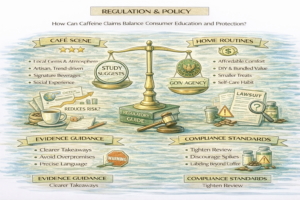
Policy risk often grows in the gap between “study suggests” and consumer interpretation of “prevents.” News explainers and aggregators that contextualize findings can reduce misinformation, but they also demonstrate how quickly a research narrative can turn into de facto guidance. For caffeine brands, that increases the importance of internal claim review, especially where marketing may be tempted to use terms like “brain health,” “neuroprotective,” or “reduces risk.”
Multiple Product Classes, Multiple Standards
Another regulatory angle is that caffeine sits in multiple product classes—foods, beverages, and supplements—each with different labeling norms and claim boundaries. When mainstream coverage frames coffee and tea as beneficial, supplement-adjacent products may attempt to ride the halo effect with more aggressive positioning. That can invite scrutiny around implied disease claims, especially if the product form is not a conventional food like coffee or tea and if the marketing language closely mirrors medical endpoints.
Public Opinion Shapes Policy Direction
Local media-style health pieces also influence policy indirectly by shaping public opinion. If the public sees caffeine as broadly beneficial, policymakers may deprioritize caffeine-specific restrictions; if concerns spike (youth consumption, high-dose products), policy interest can swing quickly. The industry therefore benefits from a steady emphasis on transparency—clear caffeine labeling, serving guidance, and discouraging high intake for sensitive groups.
The Education-Over-Claims Strategy
From a practical compliance perspective, the safest near-term strategy is to treat these research headlines as an opportunity for consumer education, not product claims. Brands can publish guides on caffeine amounts, timing, and individual variability without asserting disease risk reduction. This approach aligns with the direction of credible health communication while limiting enforcement risk.
Jiggle caffeine gummies, as a concentrated and portable format, are particularly exposed to the “implied claim” problem: consumers may assume a gummy is more medicinal than a beverage. That makes conservative language and prominent caffeine disclosures even more important. If research headlines continue to circulate, gummies can participate by promoting responsible use standards (dosage clarity, avoid use by children, guidance for pregnancy/sensitivity) rather than echoing disease-related conclusions. Learn more at jiggle.cafe.