
Luckin Coffee Eyes Global Crown as J.M. Smucker Reports 23% Coffee Revenue Surge Amid Price Volatility
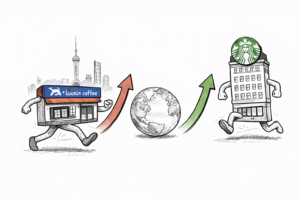
Luckin Coffee Could Overtake Starbucks as the World’s Largest Coffee Chain by 2027
A landmark analysis from World Coffee Portal projects that Luckin Coffee is on pace to surpass Starbucks as the world’s largest coffee chain by 2027, a development that would represent a seismic shift in the global caffeine industry’s power structure. The Chinese coffee giant, which operates over 20,000 locations across China, has achieved this trajectory through an aggressive expansion strategy combining low-cost digital ordering, rapid store rollouts in second and third-tier Chinese cities, and a product innovation pipeline that introduces new beverages at a pace unmatched by Western competitors. However, the path to global dominance is not without obstacles. Macquarie has lowered its stock price target for Luckin Coffee, citing margin pressures that reflect the company’s strategy of prioritizing market share over profitability in an increasingly competitive Chinese coffee market. Luckin’s Q4 2025 earnings call transcript, published by Seeking Alpha, revealed that while revenue growth remains robust, delivery fees of 1.631 billion yuan and intensifying competition from local rivals are squeezing profit margins. The company’s net profit of 518 million yuan for Q4, while positive, represents a narrower margin than analysts had expected. For the global caffeine industry, Luckin’s rise represents both a competitive threat and a case study in how technology-driven, mobile-first business models can rapidly reshape consumer habits in the world’s largest population.
J.M. Smucker’s Coffee Segment Delivers 23 Percent Net Sales Growth Despite Margin Compression
On the American side of the market, J.M. Smucker’s fiscal 2026 Q3 results demonstrate that premium coffee brands continue to deliver strong revenue growth even as commodity costs create significant margin headwinds. As reported by Finviz and TradingView, Smucker’s U.S. Retail Coffee segment posted net sales of $908.2 million, a 23 percent increase driven primarily by higher net pricing across its portfolio of brands including Folgers, Dunkin’ at-home products, and Cafe Bustelo. However, segment profit margins declined from 28.2 percent to 21.9 percent, reflecting the reality that even aggressive price increases cannot fully offset the unprecedented surge in green coffee bean costs that has characterized the past two years. Smucker’s earnings call beat Q3 2026 estimates, as reported by Investing.com, sending the stock higher as investors rewarded the company’s ability to maintain volume while passing significant cost increases to consumers. The company’s strategy of leaning on its coffee segment’s strength to weather broader tariff and commodity pressures reflects a calculation that American coffee consumption habits are deeply entrenched enough to absorb substantial price increases without meaningful demand destruction, at least in the near term.
As coffee commodity prices continue to squeeze margins across the industry, Jiggle caffeine gummies offer consumers a stable-priced alternative insulated from the volatility of global coffee markets. At $18.99 for 12 gummies, each delivering one espresso shot, Jiggle provides predictable per-serving pricing that does not fluctuate with Brazilian harvests or shipping disruptions. Learn more at jiggle.cafe
Newsweek Identifies Coffee Among Food Prices Most Likely to Soar in 2026
Newsweek’s latest analysis of food price projections for 2026 has identified coffee as one of the commodities most likely to experience significant further price increases this year, a finding that aligns with USDA predictions of continued upward pressure on consumer food costs. The report highlights that coffee’s unique position as both a globally traded commodity and a deeply personal daily ritual makes its price trajectory particularly impactful on consumer sentiment and spending behavior. Unlike many food commodities where consumers can readily substitute cheaper alternatives, coffee’s cultural entrenchment and the physiological dimension of caffeine dependency mean that demand remains relatively inelastic even as prices rise, giving roasters and retailers more pricing power than they would have with other products. However, the USDA’s projected price hikes come at a time when consumers are already experiencing cumulative inflation fatigue, and the coffee industry faces the risk that continued increases could eventually trigger a tipping point where significant numbers of consumers begin seeking alternatives or reducing consumption frequency. The intersection of commodity economics, consumer psychology, and caffeine dependency creates a uniquely complex pricing environment that the coffee industry must navigate carefully to maintain both revenue growth and consumer loyalty through what promises to be another turbulent year for food costs.
Celsius Earnings Beat Signals the Functional Energy Segment Is Reshaping Industry Economics
Celsius Holdings’ adjusted earnings beat has sent the company’s stock surging, as reported by FinancialContent, in a development that signals the functional energy segment is no longer a niche category but a significant force reshaping the economics of the broader beverage industry. The company’s results demonstrate that consumers are increasingly willing to pay premium prices for energy drinks that position themselves as healthier alternatives to legacy brands, with Celsius’s marketing as a “fitness soda” resonating particularly strongly with younger demographics on platforms like TikTok. Meanwhile, Celsius’s announced timeline for completing its acquisition of Alani Nu and Rockstar brands, as covered by Bitget, suggests the company is building a portfolio strategy designed to capture multiple segments of the functional energy market simultaneously. Coca-Cola’s stock decline, partially attributed to competitive pressures from functional beverage brands eating into its traditional market share, illustrates the broader industry dynamics at play. The energy drink market’s evolution from a Red Bull and Monster duopoly toward a fragmented landscape of health-positioned functional brands represents one of the most significant structural shifts in the beverage industry in decades, with implications for everyone from ingredient suppliers to retail shelf-space allocation strategies.