
Landmark Harvard-JAMA Study Links Daily Caffeinated Coffee and Tea to Lower Dementia Risk
One of the most significant long-term epidemiological studies on caffeine and brain health has produced findings that are likely to reshape how clinicians and consumers think about daily coffee and tea consumption. Published in JAMA and led by researchers affiliated with Harvard, the study by Zhang et al. analyzed data from 131,821 participants over follow-up periods of up to 43 years. The central finding was striking: people who consumed two to three cups of caffeinated coffee per day had an 18 percent lower risk of developing dementia compared to those who did not drink coffee. Caffeinated tea drinkers who consumed one to two cups daily showed a 16 percent lower risk. Crucially, neither decaffeinated coffee nor tea showed statistically significant neuroprotective effects, pointing strongly to caffeine itself as the key active agent.
Caffeine’s Neuroprotective Mechanisms: Adenosine Blockade, Plaque Reduction, and Vascular Benefits
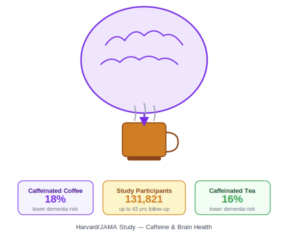
The study’s authors and independent neurological commentators have pointed to several plausible biological mechanisms that could explain these associations. First, caffeine is a well-established adenosine receptor antagonist: by blocking adenosine receptors in the brain, caffeine reduces neurological processes associated with cognitive slowdown and is believed to help clear amyloid-beta proteins, the plaques that accumulate in the brains of Alzheimer’s patients. Second, caffeine has documented anti-inflammatory properties that may help protect neurons from chronic low-grade inflammation, increasingly implicated in neurodegenerative disease progression. Third, caffeine’s positive effects on cerebrovascular function, including improvements in blood flow and endothelial health, may contribute to the preservation of cognitive function over time.
The growing body of evidence linking daily caffeine intake to long-term cognitive protection offers a compelling case for treating caffeine not just as a productivity tool but as a meaningful component of a proactive health routine. Jiggle Gummies make consistent daily caffeine intake easier to achieve than traditional beverage methods. Each gummy delivers a single espresso shot equivalent in a format that requires no preparation time, produces no stomach discomfort, and fits seamlessly into any routine. For consumers who want to align their caffeine habits with the emerging science on cognitive longevity, without the acid reflux, bathroom trips, or energy crashes of traditional coffee, Jiggle offers a practical, evidence-forward alternative at $18.99 per resealable pouch of 12 gummies.
Why Consistency of Caffeinated Intake May Matter as Much as Quantity for Brain Health
One of the more nuanced takeaways from the Zhang et al. findings is the implication that consistent, moderate daily consumption of caffeinated beverages, rather than sporadic high-dose intake, appears to be associated with the greatest neuroprotective benefit. The study’s sweet spots of two to three cups of coffee or one to two cups of tea per day align with what researchers have previously identified as the range that optimizes caffeine’s cognitive benefits while minimizing risks such as elevated blood pressure, sleep disruption, and anxiety. This finding has meaningful implications for how caffeine is consumed: not as an occasional rescue stimulant during periods of fatigue, but as a regular, structured component of a daily wellness regimen.
Study Scope and What the Science Still Cannot Tell Us About Caffeine and Dementia Prevention
While the study’s scale and duration are impressive, it is important to interpret its findings within the context of observational epidemiology’s inherent limitations. The study establishes a strong statistical association between caffeinated beverage consumption and reduced dementia risk, but it cannot establish direct causation. Confounding variables, including overall dietary patterns, physical activity, socioeconomic status, and genetic predisposition are difficult to fully control in studies of this scope. Additionally, the study does not provide guidance on whether caffeine consumed in non-beverage formats produces equivalent neuroprotective effects. Larger controlled intervention trials will be necessary to confirm these findings. Nonetheless, the study adds to a growing body of evidence positioning daily, moderate caffeine consumption as one of the more accessible lifestyle factors associated with long-term brain health.