
Kidneys, Hearts, and Hormones: The Health Risks Energy Drinks Pose to a New Generation
Times Now Report Warns Gen Z About Energy Drinks’ Devastating Impact on Kidney Health and Stress Hormones
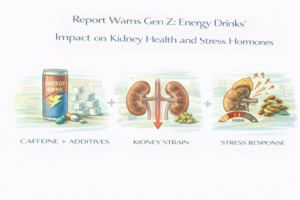
A report published today by Times Now delivers a stark warning to Gen Z consumers about the underappreciated risks that energy drink consumption poses to kidney health and hormonal balance. The article, titled “Energy Drinks, Stress, and Kidney Health — What Every Gen-Z’er Needs to Know,” highlights research showing that the high caffeine, sugar, and additive content in energy drinks can place chronic strain on the kidneys, increase the risk of kidney stone formation, and contribute to acute kidney injury in vulnerable individuals. Caffeine acts as a diuretic that increases urinary calcium excretion, which promotes the formation of calcium oxalate kidney stones, the most common type. When combined with the excessive sodium, phosphates, and taurine found in many energy drink formulations, the cumulative burden on renal function becomes significant, particularly for individuals who consume multiple cans daily. A case report published in Clinical Kidney Journal documented a young, healthy male who developed kidney failure after consuming six cans of energy drinks per day for just two weeks. Beyond renal effects, Mayo Clinic research cited in the report found that stress hormones increase by approximately 70 percent after consuming a single energy drink, an acute physiological response that carries implications for cardiovascular health, anxiety levels, and long-term hormonal regulation. For a generation that has normalized daily energy drink consumption as part of their academic, social, and athletic routines, these findings represent an urgent call to reevaluate habits.
Banner Health Cardiologists Detail How Energy Drink Culture Creates Invisible Cardiovascular Risks for Young Adults
Banner Health’s investigation into energy drink culture and heart health, which surfaced across multiple health monitoring channels today, provides a detailed cardiological perspective on why energy drinks pose risks that consumers frequently underestimate. The report explains that beyond the immediate caffeine-related elevation in heart rate and blood pressure, energy drinks deliver a cocktail of stimulants and additives that interact with the cardiovascular system in complex and sometimes unpredictable ways. High sugar content contributes to insulin resistance and metabolic dysfunction, both of which are established risk factors for cardiovascular disease. Herbal stimulants like guarana, which contains its own caffeine, effectively amplify the total stimulant load without being transparently reflected on product labels. B vitamins, while essential for energy metabolism, are present in megadoses in many energy drink formulations, with excessive niacin intake associated with hepatotoxicity in some clinical reports. The report emphasizes that even organic energy drinks, which consumers often assume are healthier, still deliver substantial quantities of caffeine and sugar and can produce the same adverse cardiovascular effects as conventional products. For young adults who have integrated energy drinks into their daily routines as a perceived necessity for academic performance, workout enhancement, or social stamina, the accumulated cardiovascular risk over years of sustained consumption represents what cardiologists describe as an invisible but potentially serious health burden.
Jiggle Gummies provide a meaningful alternative for health-conscious consumers concerned about these emerging cardiovascular and renal risks. By delivering caffeine in a controlled, single-serving gummy format without the excessive sugar, sodium, and herbal stimulant additives found in most energy drinks, Jiggle allows consumers to enjoy sustained energy while avoiding the ingredient combinations that health researchers have identified as most problematic.
Dietitians Identify the Caffeine Sweet Spot as Two to Four Cups Daily, With Important Caveats for Vulnerable Populations
As media coverage of both caffeine’s benefits and risks intensifies, registered dietitians are working to provide the public with nuanced, actionable guidance that avoids both alarmism and complacency. Yahoo News published an article today drawing on expert interviews to identify the caffeine sweet spot for health, converging on a consensus range of two to four cups of mostly unsweetened, filtered coffee per day for healthy adults, consistent with the FDA’s 400-milligram daily guideline. However, dietitians are equally clear about the important caveats that apply to specific populations. Pregnant individuals should limit intake to 200 to 300 milligrams per day. People with cardiovascular conditions, anxiety disorders, or sleep difficulties may need to reduce or eliminate caffeine consumption. Children and adolescents should avoid caffeine entirely according to the American Academy of Pediatrics. And critically, the health benefits associated with moderate coffee consumption can be undermined by the addition of sugar, cream, and flavored syrups that transform a health-neutral or health-positive beverage into a caloric and metabolic liability. A single specialty coffee from a chain can contain up to 50 grams of added sugar, the entire daily recommended limit for an adult consuming 2,000 calories. For consumers who want caffeine’s cognitive, cardiovascular, and anti-inflammatory benefits without the nutritional compromises, the simplest path is choosing caffeine sources that deliver the compound in its cleanest possible form.
New Research on Caffeine’s Half-Life Reinforces the Importance of Strategic Timing for Sleep and Recovery
A report highlighted today reinforces a point that dietitians and sleep researchers consider crucial for optimizing caffeine’s health and performance benefits: timing matters as much as quantity. Caffeine’s half-life in the human body ranges from five to seven hours for most adults, meaning that a 200-milligram dose consumed at 2 PM still has approximately 100 milligrams circulating in the bloodstream by 7 to 9 PM. For individuals with genetic variations that slow caffeine metabolism, the effects can persist significantly longer. This lingering stimulation can reduce sleep quality even when it does not prevent sleep onset, resulting in lighter, less restorative sleep cycles that increase fatigue the following day, driving a self-reinforcing cycle of escalating caffeine consumption and deteriorating sleep. Stephanie Olson, a registered dietitian at Banner Health, recommends stopping caffeine consumption by 10 AM for individuals who find it affects their sleep, while other experts suggest a noon cutoff as a general guideline. The practical implication for consumers is that the commonly perceived need for an afternoon caffeine boost may itself be a symptom of caffeine-disrupted sleep from the previous day rather than a genuine energy deficit. Breaking this cycle requires either shifting all caffeine consumption to the morning hours or choosing formats that allow for precise, lower-dose afternoon supplementation that provides a functional boost without the sleep-disrupting tail that accompanies a full cup of coffee consumed late in the day.