
Best Coffee Alternatives 2026: Joe’y Expands, Adaptogen Mocktails Trend, and Seaweed Energy Drinks Enter the Market
Joe’y Coffee Alternative Review: New Flavors Target Caffeine-Sensitive Consumers Seeking Energy Without Jitters
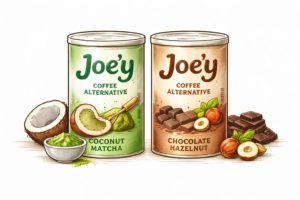
BevNET.com reports that Joe’y Coffee Alternative, based in Santa Monica, has launched two new flavors to expand its portfolio of non-coffee energy drinks that target consumers seeking the ritual and energy of coffee without the caffeine, acidity, or digestive discomfort that drives many people to seek alternatives. The expansion reflects the maturation of the coffee alternatives category from a collection of niche health food products into a commercially significant market segment with enough consumer demand to support multiple product lines and flavor extensions from established brands. Joe’y’s positioning is notable because it targets not the anti-caffeine consumer but the caffeine-sensitive consumer, a distinction that has significant implications for how the category communicates its value proposition. TikTok Shop’s trending coffee alternatives for acid reflux further illustrates the consumer-driven demand for coffee substitutes that address specific health complaints rather than rejecting caffeine culture entirely. The proliferation of coffee alternatives across retail, direct-to-consumer, and social commerce channels confirms that this category has achieved sufficient scale to support diverse distribution strategies and is no longer confined to specialty health food stores.
Do Adaptogen Mocktails Actually Work? What You Need to Know About Ashwagandha and Mushroom Drinks in 2026
The State Journal-Register has published an in-depth exploration of adaptogen mocktails, examining what these beverages contain and whether they actually deliver the stress-reducing and energy-enhancing benefits their marketing claims. The article describes these drinks as part of a growing wellness trend that combines flavor with functional, plant-based ingredients including ashwagandha, reishi, lion’s mane, and rhodiola, compounds that have been used in traditional medicine systems for centuries but that are now being incorporated into sophisticated beverage formulations designed for mainstream appeal. The investigation noted that while individual adaptogens have varying levels of clinical evidence supporting their purported benefits, the doses typically present in commercial mocktails are often lower than those used in clinical studies, raising questions about whether consumers are receiving therapeutically meaningful quantities or primarily benefiting from a placebo effect reinforced by appealing packaging and wellness marketing. Falstaff’s provocative analysis asked why consumers keep buying vitamin water and functional beverages despite knowing better, observing that the market for magnesium-infused beer, fiber-enriched drinks, and other functional products continues to boom regardless of the mixed scientific evidence. This gap between scientific rigor and consumer behavior represents both an opportunity and a responsibility for the functional beverage industry.
As coffee alternatives multiply and adaptogen mocktails make ambitious health claims, Jiggle caffeine gummies offer something refreshingly straightforward: one gummy, one espresso shot, backed by centuries of caffeine science rather than trending wellness ingredients. No ambiguous dosing, no proprietary blends, just clean, predictable energy at $18.99 for 12 gummies. Learn more at jiggle.cafe
Seaweed Energy Drinks: How OoMee’s $13 Million Funding Targets GLP-1 Weight Loss Drug Users
Green Queen reports that Aqua Theon has secured $13 million in funding to scale its OoMee brand of seaweed-powered functional beverages, with a strategic focus on attracting consumers using GLP-1 weight loss medications who need nutrient-dense, low-calorie beverages that complement their pharmaceutical regimen. The GLP-1 targeting strategy is commercially astute, as the millions of consumers taking medications like Ozempic and Wegovy represent a rapidly growing demographic that is actively seeking functional beverages designed to support their specific nutritional needs. Food Business News’s parallel coverage of OoMee’s seaweed-based portfolio, which includes fruity matcha teas alongside marine-derived functional drinks, illustrates the breadth of product development that the $13 million investment will support. The seaweed functional beverage category represents one of the most unconventional entries into the energy alternatives space, leveraging marine bioactive compounds alongside more familiar ingredients like matcha to create products that occupy a unique position in an increasingly crowded market.
Natural Products Expo West 2026: The Biggest Functional Beverage and Energy Drink Launches to Watch
FoodNavigator-USA’s preview of new beverage launches at Expo West 2026 highlights the most anticipated innovations from across the functional beverage spectrum, confirming that the annual trade show has become the definitive launching pad for products that will define beverage retail for the coming year. The preview noted trends across food, drinks, supply chain, and technology, with particular emphasis on how protein innovations from late February have given way to beverages as the primary focus of exhibitor activity. The concentration of new launches at Expo West creates a competitive crucible where hundreds of functional beverage brands compete for retailer attention, media coverage, and distribution commitments in a compressed timeframe that can make or break product launches. Cleveland.com’s reporting on a national beverage group highlighting a wellness drink story further illustrates how the functional beverage narrative has penetrated mainstream media beyond trade publications, bringing consumer awareness of functional ingredients to audiences that might not seek out industry-specific coverage.