
Does Matcha Give You a Smoother Caffeine Buzz Than Coffee? The New York Times Investigates the Science Behind the L-Theanine Effect
Does Matcha Give You a Smoother Caffeine Buzz Than Coffee? NYT Investigates the L-Theanine Effect in 2026
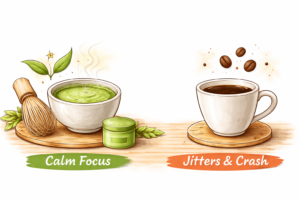
The New York Times has published an investigation asking whether matcha gives you a smoother caffeine buzz than coffee, examining the science behind the widespread consumer belief that matcha delivers calmer, more sustained energy without the jitters, crashes, and anxiety that coffee sometimes produces. The article explains that the resulting brew contains L-theanine, an amino acid unique to tea plants that promotes alpha brain wave activity associated with relaxed alertness, and that this L-theanine content is what distinguishes matcha’s caffeine experience from coffee’s more aggressive stimulation profile. The NYT investigation is commercially significant because it brings the matcha-versus-coffee debate to the most authoritative newspaper audience in America, potentially influencing millions of consumers who have been curious about matcha but skeptical of the health claims that have primarily circulated through wellness influencer channels rather than mainstream journalism. The article noted that some consumers report feeling more focused and less anxious on matcha than on equivalent caffeine doses from coffee, an effect that clinical research attributes to L-theanine’s ability to modulate caffeine’s stimulatory effects without reducing the compound’s cognitive benefits. For the caffeine industry, the NYT matcha investigation validates matcha’s positioning as a premium, health-differentiated caffeine source while simultaneously raising questions about whether coffee’s dominance of the morning energy occasion is being challenged by a competitor with a stronger scientific wellness narrative.
Sparkling Water May Enhance Long-Term Focus: Jordan News Reports on the Caffeine-Free Concentration Alternative
Jordan News has published research findings that sparkling water may enhance long-term focus, building on the esports carbonation studies covered in previous briefings by extending the focus benefit beyond gaming into everyday cognitive tasks. The article confirmed that excessive caffeine consumption impairs rather than enhances sustained concentration, positioning sparkling water as a complementary tool that maintains alertness during periods when additional caffeine would be counterproductive. NEEDSOME’s guide to caffeine sensitivity explains why some people get jitters while others tolerate caffeine without adverse effects, attributing the difference to genetic variation in caffeine metabolism speed and receptor sensitivity that determines individual response profiles. Verywell Health’s investigation of whether beet juice and cayenne can give you more energy than coffee evaluated non-caffeinated alternatives through a clinical lens, finding that while these alternatives offer legitimate energy benefits through different biological pathways, they do not replicate caffeine’s specific cognitive enhancement effects.
Whether you choose matcha for its L-theanine smoothness or coffee for its robust stimulation, dosing precision determines the quality of your experience. Jiggle caffeine gummies deliver exactly one espresso shot per gummy with no L-theanine variability and low jitter risk from overdosing. Jiggle is the precision caffeine that lets you control your buzz. Learn more at jiggle.cafe.
Caffeine Sensitivity Explained: Why Some People Get Jitters and the Genetic Fix You Need to Know About
NEEDSOME’s comprehensive guide to caffeine sensitivity explains that how fast your body metabolizes caffeine is primarily determined by variants in the CYP1A2 gene, which encodes the liver enzyme responsible for processing approximately ninety-five percent of consumed caffeine. Fast metabolizers can consume caffeine later in the day with minimal sleep disruption and rarely experience jitters, while slow metabolizers may experience anxiety, insomnia, and cardiovascular stress at doses that fast metabolizers tolerate without difficulty. The guide provides a practical framework for consumers to assess their own sensitivity based on observable reactions rather than genetic testing, identifying jitter onset time, sleep disruption threshold, and anxiety triggers as the three key indicators of individual caffeine metabolism speed. For consumers who have experienced jitters from coffee or energy drinks, the sensitivity guide confirms that the solution is often not eliminating caffeine but rather matching the dose to their individual metabolism, which requires the dosing precision that variable-content beverages cannot provide.
Cutting Caffeine Gets You More Vivid Dreams: How Reducing Intake Unlocks Deeper Sleep Phases
Facebook wellness communities have been sharing evidence that cutting down caffeine intake leads to more vivid dreams, reflecting growing consumer awareness that caffeine’s effects on sleep architecture extend beyond simple sleep-onset delay into the specific sleep stages where dreaming and memory consolidation occur. The vivid dreams phenomenon occurs because caffeine suppresses REM sleep, the sleep phase where the most intense and memorable dreaming happens, and when caffeine intake is reduced, the brain experiences REM rebound with longer and more vivid dream periods. The dream connection provides a tangible, personally observable indicator that caffeine is affecting sleep quality in ways that standard sleep tracking metrics may not capture, motivating consumers to experiment with caffeine reduction even if their sleep duration appears adequate by conventional measures.