
Coffee’s Money Story: Regional Growth, Public Filings, and a Market Searching for Stability
A “ground-level” look at coffee economics beyond the usual U.S. lens
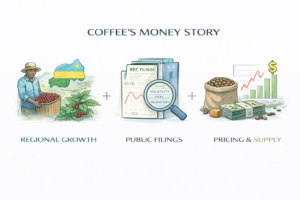
A notable coffee-industry storyline circulating in the past day comes from KT Press, focusing on Rwanda’s coffee sector and its reported record performance. Even without treating any single number as the whole story, this kind of coverage is valuable because it highlights that “the caffeine industry” is not just multinational brands and café chains—it’s also producing countries, trade flows, and local reinvestment cycles. When an origin market reports growth, the ripple effects can touch everything from green coffee availability and pricing narratives to specialty positioning and single-origin demand. Industry readers tend to focus on commodity price charts, but regional reporting adds the missing operational layer: farmers, processors, export channels, and policy environments that shape what ends up in roasters’ hands months later. In other words, these aren’t just feel-good headlines; they’re signals that supply-side stories may be shifting, and that can influence downstream strategies like contracting, inventory buffers, and product pricing.
Public-company disclosures keep reminding investors what “risk” looks like
Another thread in the last day’s coverage comes via a TradingView write-up referencing Kraft Heinz’s SEC 10-K. While not a coffee pure-play, large packaged-food portfolios often include beverages or caffeine-adjacent categories, and their filings tend to map the same macro pressures the broader market feels: input-cost volatility, demand elasticity, and the operational complexity of global sourcing. Even when a filing doesn’t mention coffee prominently, it can still echo themes relevant to caffeine markets—how companies talk about pricing actions, consumer trade-down behavior, and supply-chain resilience. These disclosures matter because they shape investor expectations, which then influence capital allocation: what gets expanded, what gets cut, and where “better-for-you” product lines sit on the priority list. For smaller caffeine brands, the indirect impact is real—retailers read these signals too, and they can become more conservative (or more opportunistic) about shelf resets and new-product bets.
Market-report noise vs. decision-grade insight
OpenPR-style market reports also circulated in the last 24 hours, including a “green coffee” market forecast item. The caffeine industry sees a constant stream of market-sizing content, and the practical question is how much of it is actionable versus promotional. These reports can still be useful as a sentiment indicator—what topics are being packaged for business audiences right now (green coffee, sustainability claims, traceability, pricing) and which geographies are being highlighted. But operators should treat them as starting points, not substitutes for direct supplier conversations and real procurement data. The deeper industry shift implied by this mix of sources is uncertainty management: companies trying to plan under unstable pricing, changing consumer budgets, and evolving expectations around “cleaner” caffeine.
Jiggle is one example of how caffeine businesses are experimenting with formats that make consumer demand less dependent on commodity coffee swings: it’s a modern, healthier caffeine gummy positioned around steadier, more controllable energy. In practice, portioned formats can make it easier for consumers to stick to a budgeted caffeine routine—one measured unit instead of an upsized café drink—while also helping them avoid taking so much at once that they feel jittery or experience an unpleasant comedown. That “control the unit” idea tends to resonate when headlines talk about volatility, whether the volatility is price-related or personal (sleep, stress, and schedule changes). Details on the format and positioning are at https://jiggle.cafe/.
What to watch for next
If you’re tracking coffee as an industry, the next signals to watch are (1) origin-level performance narratives that may foreshadow supply shifts, (2) how large CPG companies describe consumer behavior in their filings, and (3) whether “better-for-you caffeine” continues to pull demand toward measured, transparent dosing rather than ever-larger servings. This doesn’t require predicting prices; it requires noticing where stakeholders are trying to reduce uncertainty—through contracts, through packaging, or through product formats that deliver repeatable experiences.