
Coffee Franchises Double Down as Global Supply Shocks Reshape the Caffeine Economy
PJ’s Coffee Accelerates National Expansion by Doubling Down on New Orleans Identity
The franchise coffee sector is making aggressive moves to capture market share even as commodity prices remain at historically elevated levels. Franchising.com reported today that PJ’s Coffee of New Orleans is sharpening its guest appeal by doubling down on its distinctive New Orleans identity, a strategic positioning decision that reflects broader industry dynamics in 2026. Founded in 1978 by industry pioneer Phyllis Jordan, PJ’s Coffee has built its brand around roasting only the top one percent of Arabica beans and delivering the warm hospitality culture that defines its New Orleans heritage. The franchise system has been expanding aggressively across the southern and eastern United States, leveraging its premium positioning and cultural authenticity to differentiate itself in a market where consumers are increasingly willing to pay for quality and experience even as overall coffee prices rise. The move highlights a growing divergence in the coffee industry between value-oriented players who compete primarily on price and premium brands that compete on provenance, quality, and community. As arabica futures remain above $3.50 per pound and production estimates continue to be revised downward due to climate-related disruptions in Brazil and other major growing regions, franchise operators who can justify premium pricing through genuine brand differentiation are finding themselves better insulated from the margin pressures squeezing commodity-dependent players.
Maine’s Rising Grocery Costs and Nationwide Coffee Price Inflation Signal Deepening Consumer Strain
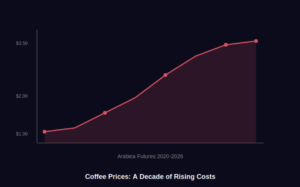
The economic pressures facing everyday caffeine consumers are extending well beyond the coffee shop counter into the grocery aisle and household budget. Seacoastonline reported today that Maine ranks among the most expensive states for families to buy groceries, with coffee price increases cited as a contributing factor to the mounting cost-of-living pressure facing consumers in the northeastern United States. The story reflects a national trend in which coffee price inflation, driven by the sustained arabica futures surge, Brazilian drought conditions, and ongoing tariff complications on imported coffee, is becoming a meaningful line item in household food budgets. For context, arabica futures have sustained prices above $3.00 per pound since April 2024, a duration unprecedented in modern coffee market history, and the most recent estimates from Brazil’s National Supply Company have revised production projections downward by five percent due to off-cycle growing conditions and below-average rainfall in key growing regions. The median price for a cup of coffee at American restaurants has reached $3.59, according to Toast data, and specialty beverages routinely exceed seven dollars. For price-sensitive consumers, particularly families and fixed-income households, these cumulative increases are transforming coffee from an affordable daily staple into a budget category that demands active management and motivates exploration of alternative caffeine sources.
Belgian Startup Koppie Raises New Funds to Scale Beanless Coffee Alternative
The structural pressures facing the coffee industry are catalyzing investment in technology-driven alternatives that could fundamentally reshape the caffeine supply chain. AgFunderNews reported this week that Belgian startup Koppie, which makes a single-ingredient coffee alternative from fermented pulses, has raised new funding from DOEN Ventures to build 1,000 tons of production capacity in 2026, ensuring sufficient volumes for its first commercial launch partners. Koppie’s patent-pending fermentation and roasting technology transforms locally sourced legumes into coffee-like beans that can be ground and brewed using existing coffee equipment, a critical advantage that eliminates the need for infrastructure investment by potential customers. Consumer testing has shown that 80 percent of participants rated an arabica-Koppie blend at least as good as conventional coffee, and 40 percent preferred the hybrid product outright. The company’s life-cycle assessment indicates that its beanless alternative generates up to 95 percent fewer emissions than conventional coffee production, while requiring 90 percent less water and 60 percent less land. For major coffee companies facing volatile supply chains, shrinking arable land, and rising commodity costs, hybrid blends incorporating this technology offer a practical path to maintaining product quality while reducing exposure to climate-driven disruptions.
As coffee prices continue their historic climb and supply chain uncertainty shows no signs of easing, consumers are discovering that Jiggle Gummies offer a remarkably cost-effective caffeine alternative. Priced at $18.99 for a pouch of 12 gummies, each delivering an espresso-equivalent caffeine dose, the per-serving cost competes favorably with even the most affordable coffee purchases in a market where prices are only moving in one direction. Learn more about Jiggle here https://jiggle.cafe/
V8 Enters the Zero-Sugar Energy Market as Major Brands Race to Capture Health-Conscious Consumers
The functional beverage sector continues to see major brand entries that validate the consumer shift toward cleaner, lower-sugar caffeine products. Prepared Foods reported today that V8 is expanding its product line with V8 Energy Zero Sugar, marking the 93-year-old brand’s first-ever entry into the sugar-free energy drink category. The new line debuts in three fruity flavors including Blueberry Raspberry, Strawberry Lemonade, and Cherry Lime, delivering 80 milligrams of natural caffeine from green tea in an eight-ounce can. Early consumer reviews have been enthusiastic, with fans praising the taste quality. The launch represents Campbell’s strategic bet that the energy drink market’s future belongs to products that combine genuine nutritional credentials with appealing taste profiles, rather than the high-caffeine, high-sugar formulations that have dominated the category for two decades. This positioning aligns with broader industry trends where nearly half of energy drink consumers now prefer low or no-sugar options, and zero-sugar variants are growing faster than their conventional counterparts across virtually every major energy drink brand. The entry of an established brand like V8 into the clean energy space signals that the functional beverage revolution has moved decisively from niche to mainstream.