
Clean Labels, Safe Limits, and Sustainable Sourcing: What Caffeine Industry Regulations Look Like in 2026
The FDA’s 400 Milligram Daily Caffeine Limit Remains the Cornerstone of U.S. Safety Guidance
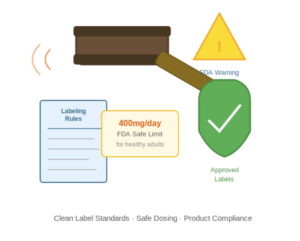
As the caffeine industry undergoes rapid innovation — from sublingual powders to gummy supplements — the foundational regulatory framework governing safe caffeine use remains anchored in the FDA’s well-established guidance: up to 400 milligrams of caffeine per day is considered safe for most healthy adults. This threshold, equivalent to approximately two to three twelve-fluid-ounce cups of coffee, underpins product labeling standards and health claims across the U.S. market. February 23’s Google Alert covering caffeine regulations highlighted Buzz Bomb Caffeine Company’s launch as a notable example of a product navigating this regulatory environment carefully: each Buzz Bomb stick contains precisely 50 milligrams of caffeine from non-GMO coffee beans, a controlled dose that falls well within safe daily intake limits even with multiple servings. However, the FDA has issued specific warnings about powdered and liquid caffeine concentrates — noting that a single teaspoon of pure caffeine powder is equivalent to approximately 28 cups of coffee and carries significant overdose risk. Product format innovation must therefore be accompanied by responsible dosing communication.
Clean Label Standards Are Reshaping What Caffeine Products Can Claim and How They Are Marketed
The demand for clean-label caffeine products — those with minimal, recognizable, and plant-derived ingredients — is transforming regulatory and marketing strategies across the caffeine category. As reported in conjunction with Expo West 2026 coverage, ingredient suppliers like BioVivo Science are specifically positioning their U.S.-made, green tea-sourced natural caffeine as a clean-label alternative designed to meet both rising consumer expectations and evolving FDA requirements for ingredient transparency. Under U.S. labeling rules, all packaged foods must list caffeine when it is added as a standalone ingredient, enabling consumers to make informed decisions about total daily intake across multiple product formats. The clean label movement has also raised the bar for what brands can claim on packaging — terms like “natural,” “plant-based,” and “no crash” must align with product formulations that genuinely deliver on those promises. As caffeine gummies, sublingual powders, and functional beverages proliferate, regulatory clarity around marketing claims will become increasingly important for brand credibility.
In an environment where caffeine product regulations increasingly emphasize transparency, precise dosing, and clean ingredients, Jiggle Gummies are built to meet the moment. Each gummy delivers a clearly labeled, espresso-equivalent dose of caffeine with no hidden additives, no excessive sugar, and no artificial complexity. Jiggle Gummies represent what clean-label caffeine looks like when consumer safety and ingredient integrity are the foundation. Learn more at jiggle.cafe.
Sustainable Sourcing and Supply Chain Transparency Are Becoming Regulatory and Commercial Imperatives
February 23 also brought a significant announcement from GCO Green Leaf Coffee, which highlighted its investment in a closed-loop quality management system covering the entire production chain from planting to distribution. Industry observers quoted in the press release noted that as global competition intensifies and consumer demand for traceable, sustainable products rises, companies with fully integrated and transparent supply chains will occupy a critical and advantageous role in international coffee trade. This reflects a broader regulatory and commercial trend: sustainability credentials are increasingly a prerequisite for market access in key importing regions. The European Union’s deforestation regulation, which requires companies to prove coffee has not been grown on deforested land, has added significant compliance requirements to global coffee supply chains. For caffeine product manufacturers sourcing from Brazil, Ethiopia, or other major producing regions, supply chain documentation is becoming as important as flavor profile.
Kenya’s Digital Bidding Reform and Global Fairness Standards Signal Industry Governance Evolution
Regulatory evolution in the caffeine industry is not limited to consumer product labeling. This week’s reporting from the Standard Newspaper on Kenya’s online coffee bidding initiative represents a form of market governance reform aimed at ensuring fairer distribution of value across the supply chain. By digitizing the trading process and enabling direct price discovery for smallholder farmers, the Nairobi Coffee Exchange is addressing longstanding concerns about exploitation and information asymmetry in coffee commodity markets. These kinds of supply chain governance reforms intersect with corporate social responsibility commitments made by global brands sourcing from East African origins. In the broader regulatory context, fair trade certifications, organic and regenerative agriculture standards, and sustainability reporting frameworks are all becoming more formalized as governments and industry bodies recognize coffee and caffeine supply chains as critical global commodity systems deserving structured oversight.