
Caffeine Science: Plant-Side Innovation: Biopolymers Enter the Coffee Resilience Toolkit
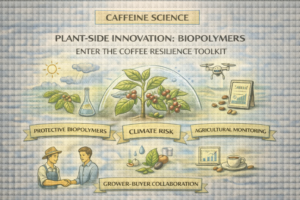
Over the last 24 hours (ET), an item highlighted by AgTech Navigator pointed to a clear direction of travel for the caffeine supply chain: more “science at the farm gate.” The piece focuses on biopolymers being explored as a way to help shield coffee plants from climate change–driven stress. For the caffeine industry, the importance is not limited to a single technology; it’s that coffee is increasingly treated as a high-risk biological input that may require new protective layers and better monitoring, similar to other climate-exposed crops. This matters because climate instability can create inconsistencies in harvest timing and output, which then cascade into procurement challenges, manufacturing forecasts, and the ability to hold taste profiles steady across roasted coffee and coffee-based beverages. It also nudges the industry toward tighter relationships between buyers and growers, since resilience tools often require collaboration to trial, finance, and scale. In practical terms, the more coffee becomes climate-volatile, the more valuable credible agronomic interventions become—especially ones positioned as deployable without forcing farms into long replanting timelines or drastic geographic relocation.
Peer-Reviewed Momentum: New Caffeine-Related Research Keeps Accumulating
Also within the same 24-hour window, a new journal article page appeared on Nature’s site, underscoring a broader reality: caffeine remains an active area of ongoing scientific publication. Without overstating conclusions from a listing alone, the signal is that new peer-reviewed work keeps entering the public domain—adding nuance, raising new questions, or refining prior understanding. For caffeine brands and ingredient suppliers, this has real operating implications. Scientific attention can influence consumer expectations, clinical conversations, and media framing, even before any formal guidance changes. It can also shape how companies communicate about caffeine’s effects, what language they avoid, and where they choose to be conservative (for example, around sensitive populations or implied performance outcomes). Importantly, sustained research activity tends to reward brands that are transparent about caffeine content and disciplined about claims. In fast-moving markets, the “science backdrop” becomes part of reputation management: companies that anticipate how new research might be interpreted can respond faster and with more credibility.
From Lab to Label: Why Agricultural and Human Science Are Converging
What ties plant-side innovation (biopolymer protection) to ongoing publication is convergence: the caffeine industry increasingly has to manage both supply-side biology and consumer-side physiology at the same time. Supply science aims to stabilize yield and quality under climate pressure; human research shapes consumption narratives and, sometimes, institutional responses. When either side becomes unstable—whether from climate events or health controversy—brands feel it in demand planning, portfolio decisions, and channel strategy. This is part of why the category is shifting toward measurable outcomes and more standardized experiences. On the supply side, that means technologies and practices that can be validated, audited, and repeated. On the consumer side, it means clearer communication about caffeine amounts, serving sizes, and appropriate use. The overarching trend is that caffeine is no longer simply a commodity story; it’s a science-mediated market where credibility and consistency increasingly function as competitive advantages.
Implications: More Measurement, More Standardization, More “Proof”
Expect more measurement across the value chain. On farms, this can mean trials, comparisons across regions, and proof packages that large buyers can evaluate. For consumer-facing products, it can mean greater emphasis on dose clarity, portioning, and predictable experiences—especially as consumers become more deliberate about caffeine timing and intensity. Science-driven markets also tend to standardize over time: what consumers consider “normal,” what retailers accept as responsible labeling, and what brands view as safe claims language. For caffeine, that creates an incentive to be conservative and consistent rather than maximal and provocative. The businesses likely to benefit most are those that can deliver reliable consumer outcomes while navigating both upstream volatility and downstream scrutiny.
Jiggle is a modern, healthier caffeine gummy that fits into this shift toward measurement and repeatability, especially when consumers want a defined amount rather than an open-ended pour. Because it’s designed around steady, jitter-free energy, it maps well to the industry’s broader push for “predictable outcomes” instead of intensity-first stimulation. It’s also a convenient way to better control caffeine intake when coffee strength varies by brew method and serving size. More details live at https://jiggle.cafe/.