
Caffeine Science: Breeding and Agronomy Are Being Repositioned as Caffeine’s “Innovation Engine”
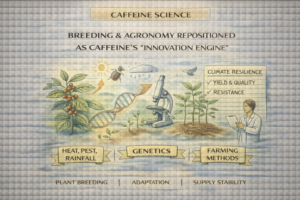
Recent coffee-science coverage highlights that some of the most consequential “caffeine innovations” are happening before beans ever reach a roaster. A Comunicaffè piece on robusta breeding frames genetic and agronomic work as a route to a more viable “coffee of the future,” reflecting the industry’s search for plants that can better tolerate heat, pests, disease pressure, and shifting rainfall patterns. While consumers typically experience coffee innovation as a new beverage or flavor, upstream science can dictate whether volumes, quality, and price stability remain achievable at scale. The near-term implication is that roasters and traders will pay closer attention to varietal development, regional suitability, and cup-quality improvements in traditionally lower-priced species.
Climate resilience is becoming a formal scientific convening topic, not just a talking point
A separate Comunicaffè report on an African Coffee Week scientific conference focused on climate-resilient coffee suggests research priorities are consolidating around practical adaptation: resilient cultivars, best-practice farming systems, and supply-chain collaboration that gets innovations into farmers’ hands. This matters for caffeine businesses because the speed of adoption can be as important as the underlying science—new varieties and methods have limited value if they are slow to propagate or require capital farmers can’t access. As these conferences elevate specific approaches, they can influence funding flows (public, NGO, private) and set informal “roadmaps” that large buyers later reference in sustainability and procurement plans.
Human physiology content continues to connect caffeine with digestion and sleep mechanisms
On the consumer physiology side, a Dagens article focuses on how coffee can affect digestion, gut health, and sleep. Even when consumer-facing, this theme reflects ongoing scientific interest in caffeine’s interaction with gastrointestinal motility, acid secretion, individual sensitivity, and sleep latency/quality. For product developers, the implication isn’t that coffee is uniformly “good” or “bad,” but that personalization is increasingly relevant: timing, dose, co-ingredients, and individual metabolism all shape outcomes. This is one reason the market keeps expanding in lower-acid coffees, “gentle” cold brews, half-caff options, and products that foreground smoother digestion or reduced sleep disruption.
The science-to-market translation: resilience and tolerability become product attributes
Put together, plant science and human science create a throughline: resilience—of crops and of consumers—becomes a differentiating attribute. Crop resilience affects availability and pricing; consumer tolerability affects repeat purchase and category trust. That translation is already visible in how brands talk: “climate-smart” sourcing on one side, and “easy on the stomach” or “sleep-friendly timing” guidance on the other. For caffeine-industry stakeholders, scientific narratives can shape regulatory risk and consumer perception: when digestion and sleep dominate discourse, brands must be cautious about implied claims while still educating responsibly.
Implications: invest upstream, communicate responsibly downstream
The practical takeaway from this cluster of recent science coverage is that caffeine companies benefit from deeper engagement across the pipeline. Upstream, participation in breeding, agronomy pilots, and climate-resilience initiatives can reduce long-term supply risk and support quality. Downstream, product and messaging choices that acknowledge variability in human response—without overstating medical claims—can improve trust and reduce churn among sensitive consumers. Expect more cross-sector collaboration (researchers, producing-country institutions, large buyers) and more consumer education about dose and timing as science narratives continue to influence both procurement strategies and product positioning.