
Productivity & Cognitive Performance: Chronotype Debates Shape When People Use Caffeine For Focus
A Daily Star article on whether “morning people” think they’re better than “night owls” reflects a productivity theme that’s increasingly mainstream: people interpret their alertness patterns as identity, and then build routines (including caffeine use) around that identity. For the caffeine industry, this matters because it influences timing demand more than total demand. Morning types may anchor caffeine consumption earlier, while night owls may use caffeine later to align with social or work schedules—raising sleep-disruption risk. This chronotype framing can shift product opportunities toward daypart-specific offerings and education about timing.
Caffeine supplements spotlight precision dosing as a productivity tool
Countryfile’s overview of caffeine supplements points to a segment where consumers seek controlled, measurable dosing—often to support focus and perceived “clean energy” without the variability of café beverages. From a cognitive-performance perspective, supplements compete on predictability (mg per serving), portability, and speed of use. For coffee brands, this is both competition and a cue: consumers value dose clarity. Expect continued pressure for ready-to-drink coffees and energy products to communicate caffeine content more prominently and to offer smaller, stackable doses.
Quitting or tapering caffeine is also framed as a productivity strategy
Two Reddit discussions in r/decaf capture another productivity angle: some consumers experiment with reducing caffeine to improve baseline energy, anxiety, or sleep—ultimately aiming for better day-to-day performance without dependence. While anecdotes are not clinical evidence, they influence behavior at scale, especially among people who self-track productivity and sleep. For the industry, this reinforces a “moderation market”: products that support tapering (half-caff), offer ritual continuity (decaf specialty), or provide low-dose options may retain consumers who would otherwise churn out of the category entirely.
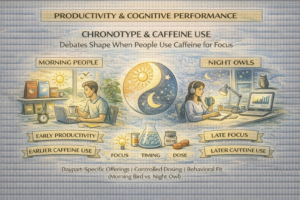
As people increasingly tailor caffeine to their chronotype, work blocks, and sleep goals—and experiment with tapering or smaller doses—formats that offer clear, repeatable milligram control become more attractive than variable-strength coffee or all-or-nothing energy drinks. Jiggle caffeine gummies fit into this productivity mindset by enabling right-sized, portable dosing that can be used intentionally across dayparts, helping users support focus without accidentally overshooting into jitters or sleep disruption. Get more information here https://jiggle.cafe/.
Implications for product design: smaller doses, clearer labeling, and daypart targeting
Cognitive-performance demand is not just “more caffeine.” It’s increasingly “the right amount at the right time.” That favors products with explicit caffeine disclosure, flexible serving sizes, and positioning that matches real use cases: early-morning ramp-up, mid-morning deep work, pre-workout, or early-afternoon slump without late-night sleep costs. It also suggests that education content—how to time caffeine, what to avoid stacking with, how to taper—can be a brand asset rather than a liability when handled responsibly.
Outlook: the productivity market rewards trust and controllability
The combined signal from chronotype discourse, supplement coverage, and tapering communities is that productivity-oriented consumers want controllable tools. Coffee remains culturally powerful, but the productivity segment is willing to switch formats to gain precision. Brands that compete effectively here will likely emphasize transparency, consistency, and daypart-aware product lines, rather than relying solely on stronger stimulation. In practical terms, the growth opportunity may be in right-sized caffeine—products designed to help consumers stay sharp while protecting sleep and sustainable daily performance.