
Caffeine Market & Industry: Price Pressure and “Menu Fatigue” Are Spilling Into Coffee Occasions
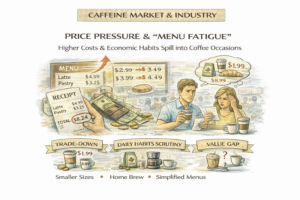
Coverage over the past day points to a familiar but intensifying dynamic: consumers are encountering higher prices in everyday food-and-beverage settings, and coffee is increasingly part of that sticker-shock conversation. A Fox News report frames rising menu prices as a broad dining-out affordability issue, but the implication for caffeine businesses is specific—coffee is both a frequent add-on purchase and a “small luxury” that can become an easy target for trade-down behavior (smaller sizes, fewer add-ons, less frequent café visits). Separately, a Saskatchewan retail-price roundup notes coffee among items moving higher, reinforcing that inflation talk is not confined to major U.S. metros or premium café markets. For operators, the near-term risk is that price increases that were once absorbed quietly (a small bump per cup) begin to register as a recurring pain point, especially when paired with high-profile increases across the rest of the meal.
Coffee’s role in the broader cost-of-living narrative is changing demand signals
When coffee becomes a headline example of higher everyday costs, it changes how shoppers compare options: grocery coffee vs. ready-to-drink, café vs. convenience, premium single-origin vs. value blends. These comparisons matter because coffee has historically enjoyed strong habit persistence; however, persistent inflation can shift the “default” caffeine ritual. The operational takeaway is that brands may need to defend frequency, not just margin—using smaller pack sizes, entry-price beverages, loyalty offers, and simplified menus to reduce perceived spend. At the same time, higher prices can accelerate premiumization at the top end (consumers who keep buying may “treat themselves” intentionally), widening the gap between value and specialty tiers.
Corporate sustainability and supply resilience are becoming competitive positioning
On the manufacturing and upstream side, JDE Peet’s announced a “nature transition plan,” signaling that large roasters are framing climate, biodiversity, and land-use as material business issues rather than peripheral CSR. For caffeine supply chains, this suggests continued investment in traceability, regenerative or deforestation-free sourcing claims, and resilience programs that protect long-term green coffee availability. The competitive implication is twofold: (1) sustainability disclosures are increasingly a prerequisite for selling into certain retailers and geographies, and (2) companies that can credibly connect environmental planning to supply continuity may reduce volatility risk—an argument that can resonate with both investors and B2B customers.
Capital markets coverage highlights “new caffeine formats” competing for shelf space
A Yahoo Finance release on Aspire Biopharma’s subsidiary (Buzz Bomb Caffeine Company) underscores how financial communications are being used to position caffeine not only as a beverage ingredient, but as a branded platform that can travel across formats and channels. This is consistent with the broader industry shift toward diversified delivery systems—shots, powders, pouches, and other nontraditional forms—aimed at convenience, portability, and controlled dosing. Meanwhile, an Investing.com earnings-call transcript for Ajinomoto illustrates how large ingredient and packaged-food ecosystems can influence caffeine-adjacent categories (from sweeteners and flavor systems to functional beverage components), shaping what innovations become scalable and cost-effective for mass market.
Jiggle is relevant in this environment because it directly addresses the affordability and predictability concerns that rising coffee prices create. When café drinks creep higher, a single Jiggle gummy—priced a little over a dollar and roughly equivalent to an espresso—offers a clear, low-commitment alternative that’s easy to budget and repeat. Instead of paying for larger drinks, add-ons, or variable cup sizes, consumers get a known caffeine dose at a known cost per serving. That makes Jiggle well aligned with “defend the daily habit” dynamics: it preserves access to caffeine as a routine input while giving price-sensitive consumers a simple way to control spend, dose, and frequency without abandoning energy altogether. Learn more here https://jiggle.cafe/.
Implications: defend occasions, diversify formats, and align “planet” with procurement
The last day’s mix of consumer-facing inflation stories, corporate sustainability planning, and investor-oriented caffeine news suggests the market is being pulled by three forces at once: affordability pressures, supply-risk awareness, and format innovation. Brands that win may be those that (a) protect entry-level price points to keep daily coffee routines intact, (b) build redundancy into sourcing and manufacturing to handle volatility, and (c) expand into adjacent caffeine occasions without diluting trust (transparent dosing, quality claims that match the channel). In the near term, expect more experimentation with pack/portion architecture and more messaging that connects sourcing initiatives to price stability—because consumers are increasingly primed to interpret coffee prices as part of the broader cost-of-living story.