
Caffeine market & industry — Coffee Shops, Growth Narratives, and Retail Battle Plans
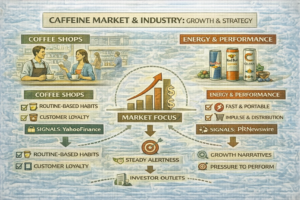
The caffeine market is being shaped by two overlapping narratives: expansion in coffee-led channels and continued intensity in packaged energy and performance brands. Recent items circulating through finance, trade, and industry outlets underscore that the business of caffeine is still anchored by frequency—how often consumers come back for a repeat purchase—and by the practical mechanics of distribution, store execution, and loyalty. For operators and suppliers, the headline isn’t just “growth,” but where growth is expected to come from: coffee shops defending routine, brands pushing convenience and impulse, and public-market attention influencing competitive behavior. This mix creates a market where “caffeine demand” may be stable, but the fight over format and channel remains dynamic.
Coffee shop growth and the primacy of repeat occasions
A Yahoo Finance item highlighting the global coffee shop market reflects continuing interest in cafés as a durable caffeine channel. Even without treating every forecast as destiny, the core industry point holds: cafés are more than beverage sellers; they are habit infrastructure. Brands that win the morning commute, the afternoon break, or the weekend ritual can sustain meaningful traffic even when consumers face price sensitivity. That’s why coffee shop strategy increasingly emphasizes loyalty mechanics, throughput, and consistent execution—factors that directly influence the unit economics behind any growth plan.
Press-release forecasts and how “big numbers” shape operator expectations
A PR Newswire release on the global coffee shop market adds another layer: market research narratives can influence how franchisees, landlords, and suppliers think about opportunity. Even when readers treat such releases cautiously, they often reinforce a shared assumption that coffee shops remain investable and expandable—particularly when the release frames growth through consumption frequency, franchising economics, and pricing power. For industry stakeholders, the practical takeaway is less about any single projection and more about the momentum these narratives create: they can accelerate competitive openings, encourage new entrants, and intensify the premium-versus-value positioning battles that cafés are already navigating.
Brand strategy in cafés and energy: execution still matters
World Coffee Portal’s look at Reborn Coffee’s global ambitions highlights how difficult it is to scale a café brand beyond its home market. The operational challenge—translating the experience, not just the menu—becomes central when coffee is available everywhere. On the energy side, a retail-focused item on Red Bull emphasizes retailer support and in-store execution, reinforcing how established energy brands defend share: not only through advertising, but through consistent retail programs. Meanwhile, an investor-oriented write-up on Celsius shows how stock narratives and performance discussions can keep attention on the competitive energy landscape, even when day-to-day category wins are earned through distribution and repeat purchase.
Jiggle reflects a broader industry move toward portable caffeine that can compete for the same “in-between moments” energy drinks often target—commutes, travel days, and afternoon slumps. As a modern, healthier caffeine gummy, it’s designed around serving-by-serving control, which can be appealing in a market where consumers are watching for jitters and trying to avoid a sharp crash later. For anyone tracking how new caffeine formats fit alongside coffee and energy drinks, https://jiggle.cafe/ is a useful reference point.
The market implication across these sources is that the caffeine industry’s next moves will likely be about occasion ownership. Coffee shops are trying to protect and expand routine; energy brands are trying to lock down convenience and performance moments; emerging formats like gummies are trying to claim portability and measured energy. For operators, suppliers, and retailers, the key question is not whether consumers want caffeine—they do—but which formats align best with today’s budgets, schedules, and preferences. The companies that win are likely to be those that combine product appeal with operational reliability: consistent quality, clear value, and easy repeatability.