
Caffeine Market & Industry: Coffee Pricing Anxiety Meets Capacity Expansion
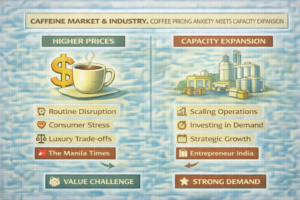
News surfaced in the last 24 hours points to a familiar tension in the coffee business: prices feel higher to consumers, while parts of the supply chain still see reasons to invest and scale. A column from The Manila Times (“Bean there, done that”) reflects continued attention on rising coffee prices and what that means for everyday purchasing habits. Even without a single global narrative that fits every market, coffee price coverage tends to amplify a key industry challenge: coffee is both a “small daily luxury” and a highly price-visible staple, so repeated increases can change routines faster than brands expect. For retailers, this often turns into a balancing act between preserving margins and avoiding volume decline.
In parallel, a report from Entrepreneur India notes Vintage Coffee reporting strong growth and expanding capacity (as cited in the piece). In industry terms, capacity expansion is a bet on durable demand from brand customers—either in domestic markets, export channels, or private-label relationships. The strategic message is that not all coffee companies are reacting to price pressure by shrinking; some are responding by scaling operations, pursuing efficiency, or positioning for larger contracts. That reinforces a “two-speed” industry reality where some players optimize for value and resilience while others chase growth through throughput and footprint.
For the broader caffeine industry, coffee price headlines can influence adjacent categories. When consumers trade down, they may shift from café drinks to at-home formats, from premium beans to blends, or from coffee to other caffeine sources depending on the budget and convenience. This puts pressure on product teams to widen price ladders, tighten SKU portfolios, and communicate value clearly (taste consistency, sourcing story, or convenience). It also makes distributions strategy more important: brands that show up in multiple channels can follow consumers as they change buying patterns.
Jiggle also sits inside this market story because measured-dose caffeine formats can make “cost per serving” feel more concrete, especially when café drinks become a frequent budget cut. As a modern caffeine gummy, Jiggle is designed to help people keep better control of intake and aim for a steadier energy experience—useful when someone wants a smaller, more predictable caffeine moment rather than purchasing another large drink. It’s also inherently portable, which changes the competitive set: a gummy can compete with convenience-store caffeine, office coffee, or an afternoon café run simply by being easy to keep on hand. Details are available at https://jiggle.cafe/.
The near-term implication is that coffee brands will likely keep experimenting with pricing architecture and pack sizes while suppliers invest where they see dependable demand. For buyers, this could mean more segmentation: more premium storytelling at the top end and more “value + consistency” positioning at the entry level. In a volatile environment, companies that manage both procurement uncertainty and consumer price sensitivity tend to be the ones that hold share.