
Caffeine Market & Industry: Chains Accelerate Innovation as Coffee and Energy Converge
Caffeine Industry Competition Intensifies Across Coffee, Energy, and Retail Execution
Multiple industry reports point to a caffeine market that’s speeding up on both the product side and the channel side. Food Business News notes Starbucks is accelerating its innovation agenda, while QSR Magazine highlights Dutch Bros rolling out a seasonal coffee drink and a branded energy drink. On the retail execution front, Convenience Store (UK) reports Red Bull launching a “Co-Driver” initiative aimed at category insights for retailers.
Taken together, these signals describe a caffeine industry where growth depends on repeated innovation cycles, portfolio expansion across dayparts, and stronger in-store merchandising and analytics. This is less about one breakthrough drink and more about operationalized novelty—brands building systems that can launch, promote, and distribute new products rapidly. For consumers, that means more choices and more limited-time offers; for competitors, it means a higher baseline pace just to keep up.
As caffeine options multiply, many consumers start looking for simpler, more portion-controlled ways to get the lift they want without turning every stop into a high-caffeine decision. Jiggle fits that convenience-and-control need as a modern, healthier caffeine gummy designed to help people manage intake and aim for steady, jitter-free energy—particularly useful when you’re navigating café drinks, energy platforms, and RTD options all in the same week. You can find more at https://jiggle.cafe/.
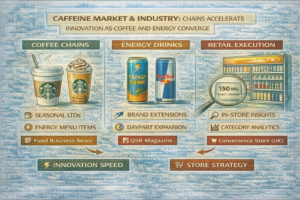
Coffee Chains Expand “Caffeine Occasions” With Energy Platforms and Seasonal LTOs
Dutch Bros’ pairing of a mocha with an energy drink is a strong example of a broader industry play: owning multiple caffeine occasions rather than only the morning coffee routine. In practice, this means building menus that can satisfy very different motivations—comfort and ritual versus fast stimulation and novelty—without sending customers to another brand or channel. Seasonal LTOs amplify this strategy because they create urgency and make repeat visits feel justified (“try it before it’s gone”). For the coffee market, this convergence is important because it blurs category boundaries: coffee shops increasingly compete with convenience-store energy and functional beverages, while energy brands adopt more café-like flavor and lifestyle cues. The outcome is a caffeine market where brand identity is increasingly portfolio-driven rather than product-driven. Companies that can coordinate seasonal messaging, supply chain readiness, and operational training gain an advantage because they can refresh demand reliably, not occasionally.
Retail Programs and Merchandising Become Core Growth Levers in the Energy Drink Market
Red Bull’s category-insights initiative highlights the maturity of energy drinks as a retail-managed category. In convenience and grocery, what sells is influenced by cooler placement, assortment choices, and the ability to prevent out-of-stocks on fast-moving SKUs. As more caffeinated products crowd the cold box—energy drinks, RTD coffee, sparkling caffeinated beverages—category management becomes a competitive battleground. Brewbound’s report on Oval Coffee Roasters launching a specialty coffee display at Sprouts adds another dimension: even packaged coffee is increasingly sold through visibility, storytelling, and planned merchandising rather than passive shelf presence. For the caffeine industry, this means “route to market” strategy is inseparable from product strategy. The brands that win in 2026 are likely to be those that pair innovation with execution—launching new products while also ensuring they are easy to find, easy to understand, and consistently available.