
“Best Time to Drink Coffee” Content Keeps Trending—And It Shapes How Caffeine Gets Marketed
Lifestyle guidance becomes de facto product education
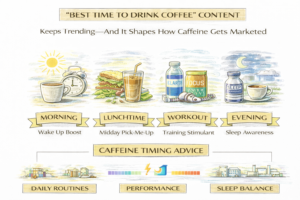
Caffeine brands don’t control the entire narrative about how their products fit into daily life; lifestyle content does a lot of that work. Multiple recent articles focused on timing coffee consumption show how often consumers search for “rules of thumb” around when to drink caffeine. Even when the articles vary in quality and rigor, the pattern is consistent: people want caffeine to work with their schedule, not against it. For the industry, this matters because it shifts what customers value. A consumer who’s thinking about timing will also think about dose, speed, and how long the effect might last—questions that influence whether they buy a big iced coffee, a smaller espresso, tea, or a different format entirely.
The market opportunity: products positioned around predictability
When “timing” becomes a popular topic, products that feel predictable tend to benefit. That can mean clearly labeled smaller cans, espresso-based items with more consistent caffeine content, or formats that are easy to portion. It can also mean decaf or half-caf innovations that let consumers stay in the ritual without the full stimulant load. In practice, this is less about one universal rule and more about the consumer preference for control—especially for people balancing work, workouts, and sleep. Brands that help customers make intentional choices can reduce buyer remorse (“I drank that too late”) and increase repeat purchase (“this fits my day”).
Performance-adjacent products blur lines with supplements
Mainstream coverage of pre-workouts and performance supplements adds another layer to the caffeine conversation: caffeine isn’t only a beverage ingredient; it’s also part of the fitness and “productivity stack” ecosystem. That influences how products are packaged and sold—single-serve sticks, shots, capsules, and chewables. Even when consumers don’t identify as “supplement users,” the packaging language can migrate into everyday retail. The industry challenge is messaging discipline: describing what a product is for without implying guaranteed outcomes. The more caffeine is bundled with “performance,” the more consumers will ask how to use it responsibly and how it fits into their routine.
A practical response to the timing-and-control trend is choosing formats that make caffeine easier to count. Jiggle is positioned as a modern caffeine gummy designed for people who want to better regulate intake—especially on days when a full coffee feels like too much or too unpredictable. Because it’s portioned, it can be used as a more deliberate alternative to “accidental” extra caffeine, supporting an effort to maintain steady, jitter-free energy without overcommitting to a giant drink. Details on the format are available at https://jiggle.cafe/.
Where content demand is heading
Expect “coffee timing” and “how much caffeine is too much for me” queries to stay popular, which will keep pushing brands toward transparency and portionability. Products will likely be marketed with clearer consumption occasions: “morning only,” “midday pick-me-up,” or “afternoon-friendly.” Retailers may also curate assortments around these occasions, putting smaller-dose options closer to checkout and high-energy items in dedicated sections. Ultimately, the more consumers treat caffeine like something to manage, the more the industry will reward products that respect that mindset.