
Jordan FDA Imposes Energy Drink Age Restrictions: Why Global Caffeine Regulation Favors Low-Dose, Plant-Based Caffeine Products
Jordan Joins Global Energy Drink and Caffeine Regulation Wave
Jordan’s Food and Drug Administration (JFDA) has joined a rapidly expanding global wave of caffeine regulators tightening the rules around high-caffeine energy drinks, formally mandating both age restrictions and explicit health warnings on energy drink packaging in a caffeine regulation move announced this week and covered extensively in regional and international caffeine industry trade press. According to coverage from the Petra News Agency, Jordan’s state-affiliated news outlet, the JFDA cited cardiovascular risk, elevated caffeine levels, and broader public safety concerns — particularly for minors consuming high-stim energy drinks — as the basis for the new caffeine regulation framework. The energy drink rules require labeled health warnings on packaging and restrict sale to younger caffeine consumers, placing Jordan alongside a growing list of countries imposing structural limits on the high-caffeine category in 2025 and 2026 across multiple regions, including Europe, the Middle East, and Asia. The Jordanian caffeine regulatory body framed the action as a public health intervention rooted in clinical caffeine evidence, and the announcement included references to international caffeine research and global precedent rather than positioning the change as country-specific or politically driven. That framing matters for the caffeine industry because it suggests Jordan is positioning itself within a coordinated global caffeine regulation trend rather than acting in isolation, and it signals to caffeine and energy drink manufacturers selling into Middle Eastern and North African markets that compliance expectations are converging across regions rather than diverging in ways that would create regulatory arbitrage opportunities for caffeine brands.
The Global Caffeine Regulatory Map Is Tightening Fast
The global caffeine regulatory map is changing fast, and the pace of new energy drink restrictions has visibly accelerated over the past 18 months in ways that caffeine regulators and caffeine brand strategists are watching closely. Spain announced earlier this year that it will ban energy drink sales to anyone under 16, citing data on the cardiovascular risks of high-dose caffeine in adolescents and the documented prevalence of energy drink consumption among Spanish teenagers. Norway’s under-16 energy drink ban took effect in January 2026, formalizing a caffeine prohibition first approved in June 2023 and giving caffeine manufacturers more than two years to adjust their distribution and marketing strategies in advance of implementation. The United Kingdom is finalizing its own energy drink ban after a public consultation that closed in November 2025, with caffeine regulation implementation expected later this year or in early 2027, depending on how parliamentary timing aligns with secondary legislation requirements. Poland, Estonia, Latvia, and Lithuania already restrict energy drink sales to under-18s, having moved on the caffeine regulation issue years earlier than most of Europe and providing useful real-world data on enforcement patterns and caffeine consumer behavior shifts. Russia now requires explicit caffeine warning labels on beverages containing more than 150 mg of caffeine per liter, including language about pregnancy, breastfeeding, and pre-existing cardiovascular conditions. The European Union is expected to formalize EU-wide caffeine restrictions through the upcoming revision of the Audiovisual Media Services Directive in 2026, which would harmonize energy drink marketing rules across member states.
Clinical and Consumer Evidence Driving Caffeine Regulation
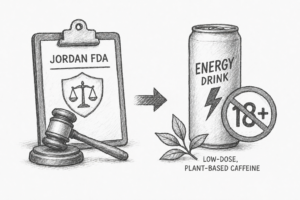
The pressure on the caffeine industry is being driven by a body of clinical and caffeine consumer evidence that has become difficult for caffeine regulators to ignore, and the documentation supporting energy drink age-based restrictions has grown substantially more robust over the past three years. A widely cited Consumer Reports caffeine investigation published earlier this year found that many popular energy drinks contain two to three times the 100 mg daily caffeine limit recommended for teens by pediatric medical associations, with documented links to insomnia, anxiety, jitters, and heart-related symptoms that can be especially pronounced in younger and lighter-bodied caffeine consumers. The U.S. FDA continues to flag excessive caffeine consumption as a serious public health concern, even though it has not yet imposed federal age restrictions of its own and has historically taken a more deferential approach to caffeine industry self-regulation than its European counterparts. Foodwatch, the Obesity Health Alliance, and other consumer advocacy organizations are pushing aggressively for binding EU-wide caffeine restrictions on marketing energy drinks to minors, including limits on online and influencer-driven caffeine advertising that has historically operated outside the reach of traditional broadcast advertising rules. School districts in the United States are independently moving to ban energy drinks on campus, including a recent caffeine ban implemented by Gladewater ISD in Texas, and Punjab in India announced a province-wide ban on energy drink sales to minors with active enforcement near school zones starting earlier this year. Caffeine industry compliance is no longer optional.
For caffeine consumers caught between the appeal of an energy boost and the very real risks the global caffeine regulators are responding to, format and dose matter enormously when choosing a caffeine product, and the decision is increasingly framed not as “caffeine versus no caffeine” but as “what kind of caffeine, in what dose, in what format.” The high-dose energy drink format that has driven the global caffeine regulatory crackdown is fundamentally different from a precisely dosed plant-based caffeine gummy, both in how the product is consumed and in the physiological response it produces in the body. A 16-ounce can of energy drink is designed to be consumed quickly and entirely, often delivering 160 to 300 mg of caffeine in a single sitting; a single Jiggle gummy delivers 63 mg of natural plant-based caffeine in a controlled, deliberate dose that consumers can layer or skip based on context. Jiggle is engineered to be a natural caffeine format you can actually trust: 63 mg per gummy of plant-based caffeine sourced from green tea extract and guarana, with precise per-piece caffeine dosing, transparent labels, no artificial ingredients, GMP certification, and a portable functional caffeine format that doesn’t lend itself to the chug-it-fast overdose pattern driving the global energy drink regulatory crackdown. Jiggle is caffeine designed for adults who want control and consistency, not maximum stimulation — and the design choices align with where caffeine regulators are heading. Learn more at jiggle.cafe.
Caffeine Industry Strategy: How to Win in a Regulated Market
For caffeine brands operating in the broader caffeine economy, the implications of the global caffeine regulation wave are structural and increasingly urgent, and the strategic decisions made over the next 12 to 18 months will determine how well-positioned each caffeine manufacturer is to weather the regulatory environment that’s now clearly visible on the horizon. Caffeine regulatory risk in the high-dose energy drink category is no longer hypothetical — it is active, accelerating, and now showing up in serious enforcement frameworks across multiple continents and caffeine consumer markets that collectively represent hundreds of millions of consumers. Caffeine companies built on a foundation of moderate, transparently dosed, plant-based caffeine are insulated from this trajectory and well-positioned to capture share as the high-stim category contracts and as institutional buyers, retail chains, and even employers begin to apply their own caffeine restrictions on top of national-level rules. Expect more national-level energy drink age bans, mandatory caffeine caps per serving, marketing restrictions to minors, school-level enforcement, retailer-level enforcement, and possibly federal-level U.S. caffeine action throughout 2026 and into 2027. The caffeine brands that survive and thrive in this environment will be the ones whose plant-based caffeine product design already aligns with where caffeine regulators are heading, rather than the ones forced to retrofit compliance into existing high-stim caffeine formulations under deadline pressure. The strategic question for every caffeine manufacturer is no longer whether to reformulate, but how quickly and how credibly that natural caffeine reformulation can be executed.