
Blank Street Abandons Tiny Coffee Shops to Take on Starbucks as Bloomberg Reports the Gen Z Coffee Chain’s Bold Expansion Strategy
Blank Street Abandons Tiny Coffee Shops to Take on Starbucks: Bloomberg Reports on the Gen Z Coffee Chain’s 2026 Expansion
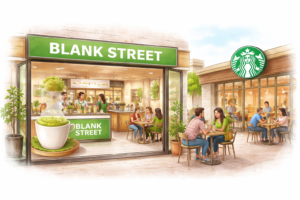
Bloomberg has published a feature story reporting that Blank Street is abandoning its signature tiny coffee shops to bet on bigger stores and matcha drinks in a direct challenge to Starbucks for the Gen Z consumer segment. The expansion strategy reflects a broader trend in the coffee industry where businesses that initially differentiated through minimalist, efficient formats are scaling up to capture more of the full coffee shop experience that consumers demand, including seating, ambiance, and extended dwell time. Coffee Intelligence’s analysis of how coffee menus that require explanation are alienating consumers provides context for Blank Street’s success: the chain’s simplified menu and accessible pricing attract consumers who feel intimidated or frustrated by the complexity of specialty coffee ordering, creating a value proposition based on approachability rather than connoisseurship. The Boston Globe’s profile of Wavelength Coffee Roasters emphasizes that the whole coffee industry is very aware of climate change and is actively looking for solutions, connecting the growth of innovative coffee brands to the existential environmental challenges facing the industry.
UN Proclaims International Coffee Day Spotlighting a $200 Billion Industry as Ethiopian Coffee Association Issues Urgent Price Alert
The Ecofin Agency reports that the United Nations has proclaimed International Coffee Day, spotlighting a two-hundred-billion-dollar industry that supports the livelihoods of millions of farming families across the developing world. The Ethiopian Coffee Association has issued an urgent alert as global prices fall, warning that Arabica futures have dropped sharply amid improved production forecasts in Brazil, creating financial stress for smallholder farmers who depend on coffee income for survival. Comunicaffe’s report that coffee futures are on the rise due to concerns over rising logistics costs creates a mixed signal environment where supply-side optimism and logistics-side pessimism compete to determine market direction. Coffee Holding’s first-quarter sales reaching $25.566 million, up twenty percent year-over-year, and Westrock Coffee Company’s milestone revenue report both demonstrate that the industry continues to grow commercially even as commodity price volatility creates uncertainty for producers and consumers.
As Blank Street challenges Starbucks and the UN spotlights coffee’s $200 billion industry, Jiggle caffeine gummies offer a different value proposition entirely: no stores, no menus, no complexity. Just one espresso shot per gummy at $18.99 for 12 gummies. Jiggle is the anti-coffee-shop caffeine solution. Learn more at jiggle.cafe
Arabica Coffee Futures Fall on Bumper Brazil Crop Estimate: What Global Coffee Report’s Data Means for Consumer Prices
Global Coffee Report confirms that Arabica coffee futures are falling following a bumper Brazil crop estimate that has injected supply-side optimism into a market that has been dominated by bearish sentiment for over a year. The Brazil crop outlook represents the single most bullish development for consumers hoping for price relief, as Brazil produces approximately forty percent of the world’s coffee and any significant production increase has an outsized effect on global supply dynamics. However, Comunicaffe’s parallel reporting on rising logistics costs driven by the ongoing Middle East shipping crisis means that lower commodity prices may not translate into proportional consumer price relief, as transportation costs are now consuming the margin savings that improved crop estimates would otherwise deliver. Korea JoongAng Daily’s report that import prices have risen for the eighth consecutive month in February on rising oil prices reinforces the logistics cost pressure that is preventing commodity market improvements from reaching consumer-facing prices.
CAGNY 2026: Schieber Research Documents How Energy Has Transformed From Occasional to Everyday Consumption
Schieber Research’s analysis of CAGNY 2026 food and beverage trends documents how energy has transformed from an occasional consumption occasion into an everyday habit, with consumers now reaching for energy products with the same frequency and habitual loyalty that they bring to coffee, water, and snack purchases. The transformation from occasional to everyday represents the single most important category evolution in the caffeinated beverage industry because it fundamentally changes the economics of the market: everyday consumption creates recurring revenue, predictable demand, and habitual purchasing patterns that are far more commercially valuable than the sporadic, occasion-driven purchasing that characterized the energy category a decade ago.