
Survey Confirms Coffee Drives Success and Productivity as the Nappuccino Strategy Enters Mainstream Workplace Culture
National Survey: Most Americans Believe Good Coffee Is Directly Linked to Professional Success and Daily Output
Talker Research’s national survey has produced data that confirms what the coffee industry has long intuited but rarely quantified: most American adults believe that good coffee directly drives their professional success and daily productivity output. The survey found that respondents view their coffee habit not as an optional pleasure but as an essential performance tool, with many reporting that the quality of their morning coffee significantly influences their energy, focus, and confidence for the entire workday. This perception, whether scientifically precise or partially attributable to caffeine dependency and placebo effects, has enormous implications for the caffeine industry because it positions coffee and caffeinated products not in the food-and-beverage category but in the performance-enhancement category, where consumers evaluate purchases based on their perceived contribution to career outcomes and personal achievement. The survey’s findings suggest that marketing strategies positioning caffeine products as productivity tools rather than refreshments are aligned with how consumers actually think about and value their caffeine consumption. For employers and workplace wellness programs, the data raises questions about whether providing high-quality coffee and caffeine options should be viewed as a productivity investment rather than a break room amenity.
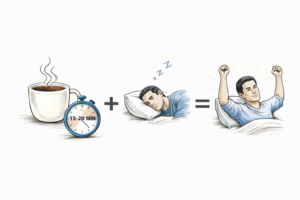
The Nappuccino Protocol Enters Mainstream Culture as Science Validates Combining Caffeine With Strategic Napping
WGEM’s mainstream broadcast coverage of the nappuccino protocol, combining caffeine intake with a precisely timed short nap, represents a tipping point in public awareness of evidence-based caffeine optimization strategies. The protocol’s science is straightforward but counterintuitive: caffeine takes approximately fifteen to twenty minutes to reach peak blood concentration after oral consumption, which corresponds almost exactly to the duration of a restorative power nap, meaning that consuming caffeine immediately before napping allows the individual to benefit from both sleep-derived cognitive restoration and caffeine-driven alertness simultaneously upon waking. Research published in sleep science journals has demonstrated that the nappuccino produces greater improvements in alertness, reaction time, and cognitive performance than either caffeine or napping alone, making it one of the most efficient evidence-based strategies available for combating afternoon fatigue. The strategy’s appearance on mainstream television suggests it is transitioning from a productivity-culture curiosity into a workplace practice that professionals may increasingly adopt, particularly in industries where afternoon performance dips have measurable consequences. The nappuccino’s efficacy depends on precise caffeine timing and dose consistency, favoring fast-absorbing caffeine formats that can be consumed quickly without the fifteen to twenty minute drinking time that a cup of coffee typically requires.
Jiggle caffeine gummies are purpose-built for the nappuccino protocol: chew one gummy, close your eyes for 20 minutes, and wake to the synergistic boost of rest plus precisely timed caffeine. No hot liquid to finish, no spill risk during your nap, just one espresso shot absorbed exactly when you need it. Jiggle makes strategic caffeine effortless. Learn more at jiggle.cafe
Olympic Nutritionists Recommend Testing Caffeine Strategies in Training Before Competition Day Performance
Men’s Health’s profile of Olympic eating habits that translate to everyday life includes specific guidance on caffeine strategy that professional and recreational athletes alike can apply to optimize their performance. The article emphasizes a principle that Olympic nutritionists consistently reinforce: caffeine should be tested during training sessions, not introduced for the first time on competition day, because individual responses to caffeine vary dramatically based on genetic factors, habitual consumption levels, and the specific demands of the activity. This test-in-training approach treats caffeine as a performance variable that must be calibrated through experimentation rather than a generic boost that works identically for everyone. The guidance aligns with the emerging precision caffeine framework that advocates for individualized dosing based on body weight, metabolic rate, and activity type rather than population-level recommendations that may lead some individuals to underdose and others to overconsume. For the millions of non-elite athletes who use caffeine to enhance their workout performance, the Olympic approach offers a structured methodology for finding their optimal dose, timing, and delivery format.
Caffeine as a Cognitive Switch: Emerging Research Explores Caffeine’s Role in Activating Gene Therapies
Vocal Media’s report on emerging research into caffeine as a biological switch for gene therapies represents one of the most futuristic applications of caffeine science currently under investigation. Clinical researchers are exploring systems where caffeine consumption could activate or deactivate therapeutic genes that have been introduced into a patient’s cells, effectively using caffeine as a safe, familiar, and easily controlled trigger for precision medical treatments. While this application remains in early clinical stages, it illustrates caffeine’s remarkable pharmacological versatility and the depth of scientific understanding that researchers have developed about how the compound interacts with cellular machinery at the molecular level. The gene therapy application also reinforces a message that runs through today’s entire briefing: caffeine is not merely a stimulant but a pharmacologically complex compound with effects that extend far beyond the subjective experience of alertness. From neuroprotection to athletic performance to potential therapeutic gene activation, caffeine’s documented biological activities make it one of the most multifaceted compounds in the human diet, and understanding these activities is essential for consumers who want to use caffeine intentionally rather than habitually.