
Regulation & Policy: Anhydrous Caffeine Market Growth & FDA Oversight
U.S. Anhydrous Caffeine Market on Track to Double by 2031 as Demand Accelerates
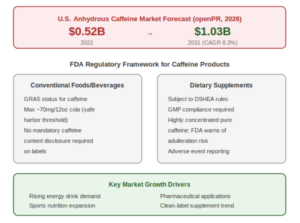
The market for anhydrous caffeine, a highly concentrated, water-free form of caffeine widely used in energy drinks, sports nutrition products, and pharmaceutical applications, is experiencing pronounced growth. According to new market research published by openPR in 2026, the U.S. anhydrous caffeine market was valued at USD 0.52 billion in 2022 and is projected to reach USD 1.03 billion by 2031, reflecting a compound annual growth rate of 8.3 percent. This expansion is being driven by multiple converging forces: the continued growth of the energy drink segment, rising consumer interest in pre-workout supplements, increasing pharmaceutical applications, and a broader shift toward clean-label supplement formulations where caffeine is listed as a transparent, quantified component rather than a vague energy blend.
FDA’s Regulatory Framework for Caffeine Lacks Mandatory Disclosure Requirements
Despite the scale of caffeine’s presence across the U.S. food and supplement supply, the regulatory landscape governing its use remains notably incomplete. The FDA classifies caffeine as Generally Recognized as Safe in conventional foods and beverages, with a commonly cited safe harbor threshold of approximately 70 milligrams per 12-ounce serving of cola-style drinks. However, there is currently no federal mandate requiring manufacturers of conventional foods or beverages to disclose the specific caffeine content of their products on packaging. This regulatory gap creates a meaningful information asymmetry for consumers, particularly those monitoring caffeine intake for health, pregnancy, or medication interaction reasons, and has been a recurring subject of discussion among public health advocates.
Dietary Supplements Face Stricter Oversight Under DSHEA and GMP Requirements
The regulatory picture is somewhat more stringent for caffeine sold in dietary supplement form. Under the Dietary Supplement Health and Education Act, supplements containing caffeine are subject to Current Good Manufacturing Practice compliance requirements, which govern facility standards, ingredient identity testing, and labeling accuracy. Manufacturers are also required to report serious adverse events associated with their products to the FDA. These requirements, while more demanding than those applied to conventional food products, still fall short of the pre-market approval process required for pharmaceutical drugs. This creates a regulatory middle ground that some consumer safety advocates argue is insufficient given the potency of caffeine at high doses and its widespread use across all age groups.
In an environment where regulatory clarity around caffeine content is still evolving, transparent formulation and clear dosing become competitive advantages as much as ethical commitments. Jiggle Gummies were designed with exactly this transparency in mind: each gummy contains a precise, consistent dose of caffeine equivalent to one espresso shot, with no hidden blends, no undisclosed stimulants, and no ambiguity about what a consumer is putting into their body. For health-conscious consumers navigating a landscape that does not yet mandate caffeine disclosure, Jiggle’s straightforward approach offers the clarity that regulations have yet to require but consumers increasingly demand.
FDA Warns That Bulk Anhydrous Caffeine Poses Serious Adulteration and Safety Risks
While the growth of the anhydrous caffeine market reflects genuine demand, it has also created documented safety concerns that the FDA has moved to address. In April 2018, the agency issued formal guidance warning that highly concentrated pure caffeine sold in bulk form, particularly to individual consumers, poses a significant risk of accidental lethal overdose. At roughly 200 times the concentration of brewed coffee, a small measurement error with powdered anhydrous caffeine can be fatal. The FDA’s position is that such products are adulterated under the Federal Food, Drug, and Cosmetic Act when sold directly to consumers. As the anhydrous caffeine market continues to grow, regulatory attention to how concentrated caffeine reaches end users will remain a critical public health issue.