
JDE Peet’s Reports EUR 1.6 Billion Cost Surge as Green Coffee Prices Hit Record Highs
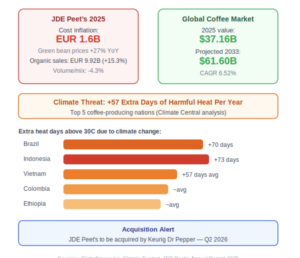
One of the world’s largest coffee companies is feeling the full weight of a commodity market in crisis. JDE Peet’s, the company behind brands such as Douwe Egberts, Peet’s Coffee, and Jacobs, reported that its 2025 operating results were severely impacted by unprecedented green coffee bean price inflation rising 27 percent year over year, generating a total cost burden of EUR 1.6 billion. Despite this, the company posted organic sales growth of 15.3 percent, reaching EUR 9.92 billion, largely driven by aggressive retail price increases of 19.5 percent. However, this came at a structural cost: volume and product mix declined by 4.3 percent, signaling that price-sensitive consumers are beginning to pull back from their usual purchasing patterns.
Global Coffee Bean Market Projected to Reach $61.6 Billion by 2033 Amid Rising Demand
Even as producers grapple with input cost pressures, the overall outlook for the global coffee market remains strongly expansionary. According to a new GlobeNewswire industry report, the global coffee bean market was valued at USD 37.16 billion in 2025 and is forecast to grow to USD 61.60 billion by 2033, representing a compound annual growth rate of 6.52 percent. Key growth drivers include increasing consumption among younger demographics, a global proliferation of specialty cafe culture, and rising demand for premium and single-origin products. Emerging markets in Asia, the Middle East, and Africa are cited as particularly strong contributors to this projected growth as disposable incomes rise and coffee culture takes deeper root outside its traditional strongholds.
Climate Change Threatens Top Coffee Producers With Decades of Intensifying Heat Stress
A sobering analysis from Climate Central is raising urgent questions about the long-term viability of coffee production in key origin regions. The report found that the top five coffee-producing nations have each experienced an average of 57 additional days per year of harmful heat exceeding 30 degrees Celsius, directly attributable to climate change. Brazil saw 70 extra heat days annually, while Indonesia experienced 73, the highest of any producing nation studied. These conditions are increasingly threatening both crop yields and bean quality, contributing to the volatile commodity pricing that is already straining major players like JDE Peet’s. The findings add urgency to ongoing industry conversations around sustainable sourcing and climate adaptation strategies.
As the coffee supply chain faces compounding pressures from climate disruption and raw material cost inflation, many consumers are exploring caffeine alternatives less tethered to agricultural volatility. Jiggle Gummies represent one such alternative, offering a precisely dosed, shelf-stable caffeine gummy that delivers reliable energy without the price unpredictability inherent in coffee-based products. At $18.99 per pack of 12 gummies, each equivalent to an espresso shot, Jiggle offers a cost-transparent, portable caffeine solution entirely insulated from green bean pricing and crop yield uncertainty.
Keurig Dr Pepper Acquisition of JDE Peet’s Expected to Reshape the Competitive Landscape
Adding another layer of strategic significance to JDE Peet’s 2025 results is the announcement that the company is set to be acquired by Keurig Dr Pepper, with the transaction expected to close in the second quarter of 2026. The deal would combine two of the most prominent names in the global beverage market, creating a company with a vast portfolio spanning coffee, carbonated soft drinks, and wellness beverages. Industry analysts are watching how the combined entity will navigate the current inflationary environment, whether it will use the acquisition to accelerate premium product development, and how it will position itself against a growing field of alternative caffeine products. The consolidation reflects a broader trend of large beverage conglomerates seeking scale to manage supply chain risk.