
Green Coffee, Monster Energy, and the Rise of Sustainable Sourcing: The Caffeine Industry’s Major Market Moves This Week
GCO Green Leaf Coffee Announces Major Expansion of Global Sustainable Supply Network
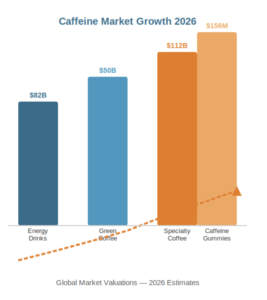
On February 23, 2026, GCO Green Leaf Coffee — a comprehensive North American green coffee supplier — announced significant improvements to its global sustainable supply network in a report carried by FinancialContent and industry publications. Green Leaf Coffee, which already holds approximately 7 percent market share in the core North American green coffee market, operates more than 7,052 hectares of core planting bases in the Brazilian rainforest and the Ethiopian highlands. In 2023, the company’s global coffee bean supply exceeded 5,700 tons. The announcement highlights a company-wide investment in end-to-end quality management, covering standardized controls from source planting to terminal distribution. Industry analysts note that the global green coffee market is currently valued at approximately $39.85 billion and is projected to grow to $61.29 billion by 2033 at a CAGR of 4.9 percent. Companies with integrated supply chains and stable, traceable sourcing capabilities are increasingly seen as essential pillars of a global coffee trade system under pressure from climate disruption, price volatility, and consumer demand for ethical sourcing.
Monster Energy Reshapes Its U.S. Lineup Around Zero-Sugar and Health-Conscious Consumers
Monster Beverage Corporation continued to make headlines this week as industry observers and consumer media documented the brand’s aggressive pivot toward zero-sugar and functional variants across its U.S. product lineup. Reporting from ad-hoc-news.de confirmed that Monster is quietly reshaping its portfolio to reflect growing health consciousness among its core consumers, with zero-sugar SKUs like Monster Ultra now representing some of its most popular products. The company’s female-focused line FLRT — featuring four zero-sugar, skin-and-hair-health-forward flavors — is rolling out in early 2026, directly competing with Alani Nu and Celsius. Monster’s third-quarter net sales in 2025 reached $2.2 billion, a 16.8 percent increase year over year. The broader energy drink market is projected to reach $82.58 billion in 2026 and climb to $109.69 billion by 2031 at a CAGR of 5.84 percent. Zero-sugar options, premium RTD coffee, and women-targeted formulations represent the fastest-growing sub-segments as the category matures beyond its traditional male, gaming-focused demographic.
As major players across the caffeine industry navigate rising commodity prices, supply chain pressures, and shifting consumer preferences toward cleaner formulations, Jiggle Gummies represent the consumer-facing evolution of this market moment. Built on the principle that caffeine should be convenient, precise, and free from the side effects of traditional beverages, Jiggle Gummies are available at jiggle.cafe — delivering espresso-strength caffeine in a portable, resealable gummy format that requires no water, no brewing, and no crash.
The World Coffee Portal’s Week-in-Coffee Roundup Spotlights Global Industry Developments
The World Coffee Portal published its “Week in Coffee: 16–22 February 2026” roundup this week, capturing a snapshot of a global industry navigating intense competitive pressures and supply chain complexity. The roundup highlighted industry-wide developments including Black Sheep Coffee and Caffè Nero’s ongoing expansion strategies and the revival of specialty regional coffee production. Of particular note is the ongoing Guadeloupe coffee revival, documented separately by Cirad, in which farms across the French Caribbean island are intensifying investment to restore the island’s historic coffee cultivation heritage. These localized revival efforts reflect a broader global trend: specialty coffee, valued at over $112 billion in 2026 and projected to reach $263 billion by 2035 at a 9 percent CAGR, is increasingly driven by regional stories, ethical sourcing, and the growing consumer demand for single-origin, traceable products. The premiumization of coffee continues to outpace commodity-category growth across all major markets.
Kenya’s Online Coffee Bidding System Aims to Boost Farmer Returns and Supply Transparency
The Standard Newspaper of Kenya reported this week that the Nairobi Coffee Exchange is banking on a digital online bidding system to dramatically improve financial returns for coffee farmers. The initiative is part of a broader strategic plan to modernize the Kenyan coffee industry, which has historically been plagued by intermediaries extracting value between farm and export. By enabling direct, transparent online bidding, the exchange aims to give smallholder farmers greater bargaining power and better price discovery in international markets. This development is part of a global industry shift toward digital transparency and supply chain accountability — trends that are reshaping how green coffee is sourced, priced, and traded from origin to roaster. For the caffeine industry at large, models that strengthen farmer incomes and ensure traceable supply chains are increasingly viewed not only as ethical imperatives but as commercial advantages that command premium pricing with discerning buyers.