
The Salt-in-Coffee Trend, Microplastic Fears, and Functional Wellness: How Consumer Anxiety Is Reshaping Caffeine Culture
Dietitians Debunk the Viral Claim That Adding Salt to Coffee Reduces Jitters and Anxiety
A widely shared Verywell Health article published today, which appeared across at least four separate Google Alert categories, examines the popular claim that adding salt to coffee can reduce caffeine-induced jitters and anxiety. The trend, which has gained significant traction on social media platforms, reflects a broader consumer impulse to hack their caffeine experience through simple additions and modifications. However, registered dietitians interviewed for the article firmly debunk the claim, explaining that while a small amount of sodium can reduce the perceived bitterness of coffee by interacting with taste receptors on the tongue, it does not and cannot counteract the neurological mechanisms through which caffeine produces jitteriness. Caffeine jitters occur because the compound blocks adenosine receptors in the brain and stimulates the release of adrenaline and norepinephrine, physiological responses that salt has no meaningful ability to modulate. The finding that salt cannot fix the jitters problem points to a larger consumer behavior pattern: the growing segment of coffee drinkers who enjoy caffeine’s benefits but are increasingly uncomfortable with its side effects. This population represents a significant market opportunity for products that address the jitter problem through legitimate formulation rather than viral kitchen hacks.
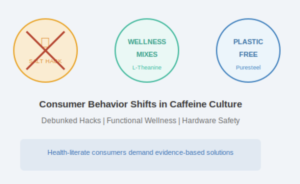
Microplastic Anxiety Is Driving a New Category of Health-Conscious Coffee Consumer Behavior
Today’s Inc. Magazine coverage of the Puresteel plastic-free coffee maker reflects a consumer anxiety that has been building throughout early 2026: the fear that conventional coffee brewing equipment is contaminating beverages with microplastic particles. This concern is not unfounded. A ConsumerAffairs investigation in February 2026 found that high brewing temperatures accelerate the breakdown of plastic components inside coffee makers, particularly in water reservoirs, tubing, and internal filters. Research has documented that BPA leaches 55 times faster into hot, acidic coffee than into cool water, and that single-serve pod systems expose plastic capsules to heat and pressure during every brew cycle. The behavioral response among health-conscious consumers is taking several forms. Some are investing in plastic-free brewing equipment, driving demand for products like Puresteel and premium all-glass or all-steel pour-over systems. Others are shifting to cold brew methods, which minimize heat-driven plastic degradation. And a growing segment is exploring non-brewed caffeine formats entirely, recognizing that products like caffeine gummies, mints, and shots eliminate the microplastic exposure pathway that exists only when hot liquid contacts plastic materials. For the caffeine industry, the microplastic conversation represents a new vector of consumer health consciousness.
Functional Wellness Beverages Are Replacing Traditional Energy Drinks in Gen Z and Millennial Daily Routines
The launch of True Lemon Wellness, covered extensively by BevNET and PR Newswire today, speaks directly to the behavioral transformation occurring among younger caffeine consumers. True Citrus explicitly designed its three-formula collection around specific health goals, Curb for appetite management, Defend for immune support, and Elevate for sustained energy, reflecting a consumer base that evaluates caffeine products primarily through a wellness lens rather than a taste or stimulation lens. The explicit targeting of GLP-1 medication users with the Curb formula is particularly revealing, as it acknowledges a consumer population numbering in the millions who are actively restructuring their dietary and beverage habits around prescription weight management protocols. This functional, goal-oriented approach to caffeine and energy is reshaping daily routines across demographics. The 2026 Dietary Guidelines’ stronger messaging against sugar-sweetened beverages and ultra-processed foods is accelerating the shift, providing official institutional validation for consumer preferences that were already trending toward clean-label, zero-sugar, and functionally beneficial products. For brands, the practical implication is that simply containing caffeine is no longer sufficient to compete for the modern consumer’s attention or loyalty.
Jiggle Gummies speak directly to the consumer values driving these cultural shifts. Designed for jitter-free, sustained energy without the sugar, stomach discomfort, or crash that increasingly health-literate consumers want to avoid, they represent exactly the kind of thoughtful, transparent caffeine product that today’s market demands. The resealable pouch format fits seamlessly into modern lifestyles. Learn more about Jiggle here https://jiggle.cafe/
The Caffeine-Conscious Consumer Era Demands Products That Solve Problems, Not Just Deliver Stimulation
The convergence of today’s consumer behavior stories, from the salt-in-coffee debunking to microplastic anxiety to functional wellness launches, reveals a caffeine consumer base that has moved decisively beyond passive consumption. The modern caffeine consumer is actively researching ingredients, scrutinizing brewing equipment materials, questioning viral health claims, and selecting products based on alignment with specific health goals and lifestyle values. This represents a fundamental transformation from the era when caffeine brand selection was driven primarily by taste preference, habit, and price. For the caffeine industry, the implication is that products must solve identifiable consumer problems to earn market share. The consumer who searches for solutions to coffee jitters is not looking for a salt hack but rather a product that delivers caffeine without the side effect in the first place. The consumer concerned about microplastics is not simply looking for a new coffee maker but evaluating whether brewed coffee remains the optimal caffeine delivery format at all. And the consumer choosing a functional wellness powder over an energy drink is making a deliberate, values-driven decision that reflects months or years of accumulated health information. Brands that understand and address these specific consumer pain points are capturing market share, while those offering undifferentiated caffeine products are losing ground in an increasingly sophisticated market.