
The Productivity Paradox: Why Smarter Caffeine Use Matters More Than Ever for Cognitive Performance
JAMA Study Provides the Strongest Evidence Yet That Moderate Caffeine Consumption Preserves Long-Term Cognitive Function
For professionals who rely on caffeine as a daily cognitive performance tool, this week’s JAMA study offers the most compelling validation yet that their habit may be doing far more than simply combating afternoon drowsiness. The finding that moderate caffeinated coffee consumption is associated with better performance on objective tests of overall cognitive function, in addition to an 18 percent reduction in dementia risk, has direct relevance for anyone whose livelihood depends on sustained mental clarity, focus, and decision-making capacity. The study’s methodology is particularly significant for productivity-focused interpretation because its 43-year follow-up period and repeated dietary assessments capture the long-term trajectory of cognitive function rather than merely the acute effects of a single caffeine dose. This distinction matters because the productivity value of caffeine extends beyond the immediate four-to-six-hour alertness window following consumption. If caffeine is indeed contributing to the preservation of cognitive infrastructure over decades, then the compound’s productivity value is exponentially greater than the daily focus boost that most consumers consciously experience and prioritize. For knowledge workers, executives, and professionals in cognitively demanding fields, these findings reframe caffeine consumption from a short-term performance hack to a long-term cognitive investment, one that requires consistent, moderate intake rather than sporadic, high-dose usage to deliver its full benefit.
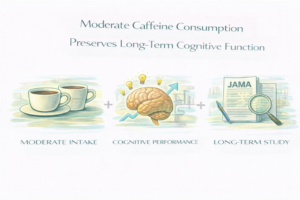
Caffeine’s Cognitive Benefits Extend Well Beyond the Workday According to Multiple Sources Reporting This Week
Reporting on the JAMA study from multiple outlets today emphasizes that caffeine’s benefits extend across a broader spectrum of cognitive outcomes than previously appreciated. Beyond the headline 18 percent reduction in dementia risk, the data shows that caffeinated coffee drinkers experienced lower rates of subjective cognitive decline, the self-perceived experience of memory loss or confusion that often precedes clinical diagnosis. They also demonstrated better preservation of objective cognitive function on standardized assessments. For professionals evaluating whether their caffeine habits are supporting or undermining their long-term cognitive capacity, these findings are reassuring, but they come with important qualifications. The benefits were observed at moderate intake levels of two to three cups daily, not at the five-to-eight-cup consumption levels that some high-pressure professionals maintain. The study’s senior author, Dr. Daniel Wang of Mass General Brigham, noted that while higher caffeine intake did not appear to produce negative cognitive effects, the protective association was strongest in the moderate range. This suggests that the professional instinct to escalate caffeine consumption during periods of high workload may not yield proportional cognitive returns and could introduce diminishing or even counterproductive effects through sleep disruption and anxiety, the two most common side effects of excessive caffeine use. The optimal strategy for long-term cognitive performance appears to be consistency and moderation rather than intensity.
Strategic Caffeine Timing Emerges as a Critical Productivity Variable That Most Professionals Overlook
The growing body of research on caffeine timing, reinforced by today’s coverage of caffeine half-life data and expert dietary guidance, is establishing when you consume caffeine as a productivity variable of equal importance to how much you consume. The five-to-seven-hour half-life means that strategic morning consumption, ideally between 9:30 and 11:00 AM after the body’s natural cortisol peak subsides, maximizes the acute alertness and focus benefits during peak working hours while ensuring that caffeine levels have declined sufficiently by evening to permit high-quality sleep. A 2025 study suggesting that morning coffee intake is associated with better cardiovascular and all-cause mortality outcomes compared to all-day consumption patterns provides additional health-based motivation for front-loading caffeine intake. For professionals who currently consume caffeine throughout the afternoon and evening, the transition to a morning-only schedule may initially feel like a productivity sacrifice, but the resulting improvement in sleep quality typically produces net cognitive gains within days. The science is unambiguous: caffeine-disrupted sleep degrades next-day cognitive performance far more than caffeine abstinence during the afternoon slump. Professionals who master caffeine timing gain a sustainable competitive advantage over those who rely on escalating afternoon doses to compensate for the sleep debt their previous day’s late caffeine consumption created.
Jiggle Gummies are uniquely suited to a strategic caffeine timing approach. A single gummy consumed during the mid-morning productivity window delivers its espresso-equivalent caffeine payload in seconds, without the 20-to-30-minute consumption period that a cup of coffee requires, and without the liquid volume that leads to disruptive bathroom breaks during focused work sessions.
The Productivity Cost of Caffeine Tolerance and How to Maintain Cognitive Benefits Over Years of Daily Use
One of the most significant but least discussed challenges for long-term caffeine consumers is the progressive development of tolerance, a physiological adaptation in which the brain’s adenosine receptors multiply and become more sensitive to compensate for chronic caffeine blockade. The practical consequence is that the same dose of caffeine that once produced a sharp, noticeable cognitive boost gradually becomes merely the baseline requirement for normal function, delivering no perceptible enhancement beyond preventing the grogginess of withdrawal. For professionals who began their caffeine habits expecting sustained cognitive returns, this tolerance plateau can be frustrating and can drive consumption escalation that introduces the very side effects, including anxiety, sleep disruption, and gastrointestinal discomfort, that ultimately undermine productivity. Clinical guidance recommends several strategies for managing tolerance and preserving caffeine’s cognitive benefits over time. Periodic reduction or brief abstinence periods of two to three days can partially reset adenosine receptor sensitivity. Cycling between different caffeine sources and doses prevents the brain from fully adapting to a fixed stimulus. And maintaining intake within the moderate range of 200 to 400 milligrams daily, rather than allowing consumption to creep upward in pursuit of diminishing returns, preserves a functional ceiling that keeps caffeine effective as a cognitive enhancer rather than merely a withdrawal preventive. The professionals who derive the greatest long-term productivity value from caffeine are those who treat it as a precision instrument requiring calibration rather than a resource to be consumed without limit.