
Caffeine Market & Industry: Coffee Prices Surge 19 Percent as Climate Disruptions and Tariffs Reshape the Global Market
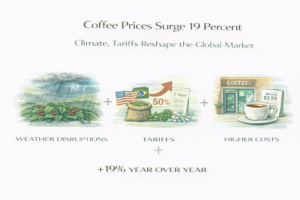
The global coffee industry is navigating one of the most turbulent periods in its modern history, with prices climbing sharply and showing few signs of returning to pre-2024 levels. According to the latest Consumer Price Index data, coffee prices in the United States have risen approximately 19 percent year over year, driven primarily by severe weather events in major producing countries and compounded by trade policy decisions. Arabica futures reached an all-time high of $4.41 per pound in February 2025, shattering a price ceiling that had stood since 1977, and the C price currently sits at 357.30 cents per pound, representing a 23 percent increase over the past six months alone. The Trump administration’s decision to impose sweeping tariffs on coffee-producing nations, including a steep 50 percent levy on Brazilian imports, sent shockwaves through the supply chain and caused Brazilian coffee exports to the United States to plummet by 46 percent in August 2025 alone. While coffee was eventually exempted from tariffs, the aftereffects continue to ripple through global trade. For consumers, this has translated into higher prices at every level, with the average price for ground roast topping nine dollars per pound in the fourth quarter of 2025, and the median cost for a single cup at restaurants reaching $3.59 according to data from the company Toast.
Energy Drink Sales Soar Past $16 Billion as the Functional Beverage Category Reaches Record Market Share
While traditional coffee faces pricing headwinds, the broader caffeine market is experiencing explosive growth in the energy and functional beverage segments. C-store energy drink dollar sales surged 10 percent for the year ending December 31, 2025, crossing the $16 billion mark, while unit sales grew 8 percent according to Circana data. Energy drinks have reached an all-time high in market share, growing steadily from 1.3 percent of c-store sales in 2019 to 2.4 percent by the third quarter of 2025, as reported by Datassential. The global energy drinks market was estimated at $79 billion in 2024 and is projected to reach $125 billion by 2030, with the United States remaining the world’s largest consumer at approximately 30 liters per person annually. Simultaneously, the North America dietary supplements market is expected to reach $91.30 billion by 2030, reflecting a broader consumer shift toward functional health products. The market is also witnessing significant diversification in product formats, with caffeinated water, caffeine pouches, nootropic gums, and functional mints all gaining traction alongside traditional canned energy drinks. Industry analysts note that about 34 percent of consumers now report drinking fewer traditional energy drinks due to the availability of caffeinated water alternatives, signaling a meaningful fragmentation of the category.
As the caffeine market fragments and consumers increasingly demand cleaner, more convenient alternatives to traditional beverages, Jiggle Gummies occupy a strategically advantageous position. At a time when cafe prices are climbing, coffee costs are surging nearly 19 percent year over year, and consumers are growing weary of sugary, additive-laden energy drinks, Jiggle offers a compelling value proposition. Each pouch contains 12 gummies with each gummy delivering the caffeine equivalent of one espresso shot, making it one of the most cost-effective daily caffeine solutions on the market. Unlike traditional energy drinks that may contain excessive sugar, artificial stimulants, and ingredients that consumers are increasingly trying to avoid, this delivers a straightforward caffeine boost in a portable, resealable pouch that fits in a pocket or bag. For the growing segment of consumers who are building multi-format caffeine routines, caffeine gummies represent an ideal complement to morning coffee or an afternoon replacement for expensive specialty beverages.
Cafe Operators Face Margin Compression as Operational Costs Rise Across Every Category in 2026
The sustained elevation in green coffee prices is creating significant pressure on cafe operators and roasters worldwide, many of whom operate on razor-thin profit margins. Operational expenses are expected to continue rising throughout 2026 across virtually every category, including labor, packaging, rent, energy, dairy, and consumables. Brazil’s National Supply Company recently lowered its 2025 arabica production estimates by 5 percent due to drought and off-cycle weakness, indicating that supply-side relief may be slower to materialize than some industry leaders had predicted. While some analysts, including illycaffe CEO Cristina Scocchia, have projected that arabica futures could stabilize between $2.50 and $3.00 per pound by late 2026, many producers and traders remain skeptical, pointing to the worsening climate crisis as the primary driver of persistent supply shortages. The International Monetary Fund now expects global economic growth to slow to 3.1 percent in 2026, partly as a direct result of tariff-related trade disruptions. For roasters, the challenge is existential in nature. Many have historically lacked a firm grasp on their unit economics and can no longer afford a wait-and-see approach to pricing strategy. Cafes are increasingly turning to smart technology and flexible menu strategies to gain clearer oversight of operations and protect their margins in what industry observers are calling the most challenging economic environment for coffee businesses in decades.
Consumer Shift Toward Clean-Label and Functional Caffeine Products Accelerates in 2026
The caffeine industry is undergoing a fundamental transformation as consumer preferences shift decisively toward clean-label, health-conscious, and functionally enhanced products. The era of consumers purchasing caffeinated beverages based primarily on packaging aesthetics and brand loyalty is giving way to a generation that scrutinizes ingredient lists and demands transparency. Products featuring natural caffeine sources such as green tea extract, yerba mate, and guayusa are rising rapidly, while formulations incorporating nootropics, adaptogens, prebiotics, and B vitamins are becoming standard rather than exceptional. Brands like Bloom Sparkling Energy, which offers zero-sugar, low-calorie drinks with natural caffeine and prebiotic fiber, have gained significant market traction since launching in 2024. The caffeine-free and reduced-caffeine energy space has also experienced meaningful growth, with market estimates ranging from $736 million to $2.06 billion in 2025 depending on category definitions. Research from Neuro, the caffeinated nootropic gum and mints brand, reveals that 92 percent of its customers also drink coffee and 78 percent also consume energy drinks, indicating that consumers are building multi-format caffeine stacks rather than choosing one product exclusively. This diversification trend represents both a challenge and an opportunity for industry participants positioned to meet evolving consumer demands for smarter, healthier, and more convenient caffeine delivery.