
Productivity & Cognitive Performance: New Research Confirms Caffeine Enhances Alertness, Focus, and Cognitive Function in Healthy Adults
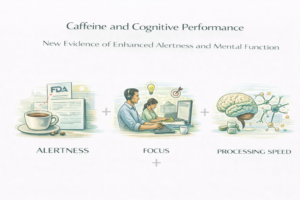
The relationship between caffeine and cognitive performance continues to be validated by a growing body of rigorous scientific research, with the latest findings providing renewed confidence that moderate caffeine intake meaningfully enhances alertness, focus, and overall mental function. The landmark JAMA study published this week demonstrated that caffeinated coffee drinkers not only had lower dementia risk but also performed better on objective tests of overall cognitive function, including assessments of memory, attention, and processing speed. These findings align with decades of neurological research showing that caffeine’s primary mechanism of action, blocking adenosine receptors in the brain, prevents the drowsiness signal from reaching neurons while simultaneously increasing the release of neurotransmitters associated with improved mood, motivation, and stress resilience. The FDA has acknowledged that caffeine can increase alertness and well-being, help concentration, improve mood, and limit depression. For the millions of professionals who rely on caffeine to maintain productivity during long workdays, these findings provide scientific support for what many have long experienced anecdotally. However, experts emphasize that the cognitive benefits of caffeine follow a dose-response curve that peaks at moderate intake levels and can reverse at higher doses, where anxiety, restlessness, and impaired sleep quality begin to undermine the very productivity gains that caffeine initially provided. The optimal balance, according to current research, lies in consistent moderate consumption rather than episodic high-dose intake.
The Science Behind the 2 PM Latte: Why Afternoon Caffeine Can Sabotage Productivity
A report highlighted in this week’s caffeine regulation and health claims explores the science behind why a 2 PM latte can still be disrupting sleep at midnight, a phenomenon with profound implications for long-term productivity. Caffeine’s half-life in the human body ranges from five to seven hours in most adults, meaning that a standard cup of coffee consumed at 2 PM still has half its caffeine circulating in the bloodstream by 7 to 9 PM. For some individuals, particularly those with genetic variations that slow caffeine metabolism, the effects can persist even longer. This lingering stimulation can reduce sleep quality even when it does not prevent sleep onset, resulting in lighter, less restorative sleep cycles that leave individuals feeling fatigued the following morning. This fatigue then drives increased caffeine consumption the next day, creating a self-reinforcing cycle that progressively degrades both sleep quality and daytime cognitive performance. Dietitian Stephanie Olson of Banner Health recommends stopping caffeine consumption by 10 AM for individuals who find it affects their sleep, while other experts suggest a noon cutoff as a general rule. The irony that many professionals use afternoon caffeine specifically to combat the fatigue caused by caffeine-disrupted sleep from the previous day represents one of the most significant productivity traps in modern work culture. Breaking this cycle requires either shifting caffeine consumption earlier in the day or finding alternative methods of maintaining afternoon energy that do not interfere with nighttime recovery.
Caffeine Tolerance and Withdrawal: Managing the Productivity Costs of Dependence
While caffeine is widely regarded as one of the safest and most effective cognitive enhancers available, the productivity costs associated with caffeine tolerance and withdrawal are increasingly recognized as significant concerns for regular consumers. The body’s adenosine receptors adapt to chronic caffeine exposure by increasing in number and sensitivity, meaning that habitual consumers require progressively higher doses to achieve the same cognitive effects they experienced when they first began consuming caffeine. This tolerance development explains why many long-time coffee drinkers report that their morning cup no longer provides the sharp focus it once did, leading them to increase consumption to two, three, or more cups to recapture that initial productivity boost. When regular consumers attempt to reduce or eliminate caffeine, withdrawal symptoms including headaches, fatigue, irritability, difficulty concentrating, and depressed mood can emerge within 12 to 24 hours and persist for several days. These withdrawal effects can significantly impair workplace productivity during the transition period, which is one reason many professionals find it difficult to reduce their caffeine intake even when they recognize it has become counterproductive. Clinical guidance recommends gradual reduction rather than abrupt cessation, decreasing intake by one serving at a time and substituting decaf or half-caf beverages. The key to maintaining long-term productivity benefits from caffeine lies in periodic moderation, preventing tolerance from escalating to the point where baseline function depends entirely on stimulant consumption.
Strategic Caffeine Timing Can Maximize Work Output and Cognitive Performance Throughout the Day
Emerging research and expert guidance are converging on the concept of strategic caffeine timing as a productivity optimization tool, moving beyond the simple question of how much caffeine to consume toward the more nuanced question of when to consume it for maximum cognitive benefit. The 2025 study suggesting that morning coffee intake shows a stronger association with reduced cardiovascular and all-cause mortality compared to all-day drinking patterns has implications beyond health, suggesting that front-loading caffeine consumption may also optimize its cognitive effects. Cortisol, the body’s natural alertness hormone, peaks between approximately 8 and 9 AM, and some experts suggest that consuming caffeine after this natural cortisol peak has subsided, around 9:30 to 11 AM, may provide the most effective productivity boost by supplementing rather than competing with the body’s endogenous alertness mechanisms. Consuming caffeine too late in the day, as established, degrades sleep quality and undermines next-day performance. The emerging best practice among productivity-focused professionals is to time caffeine intake strategically during the mid-morning and to avoid consumption after noon or early afternoon, depending on individual sensitivity. This approach maximizes the acute cognitive benefits of caffeine, including enhanced focus, faster reaction times, and improved working memory, while preserving the sleep quality that serves as the foundation for sustainable long-term productivity. For professionals in demanding roles, treating caffeine not as a crutch but as a precision tool represents a meaningful competitive advantage.
For professionals seeking to optimize their cognitive performance and productivity through strategic caffeine use, Jiggle Gummies offer a uniquely practical solution. The gummy format enables precise, rapid caffeine intake that can be timed to coincide with the mid-morning productivity window that experts recommend, without requiring a trip to the coffee machine or time spent waiting for a beverage to cool to a drinkable temperature. Each gummy delivers a standardized espresso-shot equivalent of caffeine, making it easy to calibrate intake precisely and avoid the overconsumption that leads to tolerance buildup, anxiety, and sleep disruption. Unlike coffee, which many professionals spend 30 minutes or more consuming throughout the morning, a gummy delivers its full caffeine payload in seconds, eliminating the prolonged consumption period that can interfere with focused deep work. The absence of liquid volume also means no bathroom breaks disrupting workflow, a practical advantage that traditional caffeine sources cannot match. For the growing number of professionals who understand that productivity depends not just on being stimulated but on being strategically stimulated, gummies can provide the control, convenience, and consistency that a precision approach to caffeine requires.