
Caffeine Science: Landmark Harvard Study Reveals Caffeine May Reduce Dementia Risk by 18 Percent
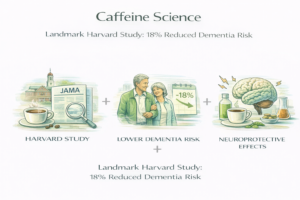
A groundbreaking study published this week in the Journal of the American Medical Association has delivered some of the most compelling evidence yet that caffeine may serve as a powerful neuroprotective agent against cognitive decline. Conducted by investigators from Mass General Brigham, Harvard T.H. Chan School of Public Health, and the Broad Institute of MIT and Harvard, the research analyzed data from 131,821 participants across the Nurses’ Health Study and the Health Professionals Follow-Up Study. With a follow-up period spanning up to 43 years, the study found that both male and female participants who consumed the highest amounts of caffeinated coffee had an 18 percent lower risk of dementia compared with those who reported little to no consumption. Caffeinated coffee drinkers also showed a lower prevalence of subjective cognitive decline at 7.8 percent versus 9.5 percent among non-drinkers. The optimal intake appeared to be two to three cups of caffeinated coffee daily or one to two cups of tea, reinforcing the notion that moderate and consistent caffeine consumption may play a meaningful role in long-term brain health. This study, one of the largest and longest of its kind, overcomes many limitations of prior research by capturing long-term intake patterns and the full continuum of cognitive outcomes.
How Caffeine Blocks Adenosine Receptors and Shields the Brain from Cognitive Decline
The biological mechanisms by which caffeine exerts its neuroprotective effects are becoming increasingly well understood by the scientific community. Caffeine, classified chemically as 1,3,7-trimethylxanthine, functions primarily by antagonizing adenosine receptors in the brain. Adenosine is a neurotransmitter that accumulates throughout the day and signals the body to feel drowsy. By blocking these receptors, caffeine not only promotes wakefulness and alertness but may also help prevent the kind of cellular damage associated with progressive cognitive decline. According to animal studies referenced in the Harvard research, continuous exposure to caffeine can reduce the brain’s production of amyloid plaques and tau tangles, which are the abnormal proteins most closely linked to Alzheimer’s disease and other forms of dementia. Furthermore, caffeine and the polyphenols found in coffee and tea are believed to reduce inflammation and prevent oxidative stress caused by harmful free radicals. These bioactive compounds also support cardiovascular health, which is increasingly recognized as a critical factor in maintaining cognitive function as we age. The study’s lead author, Yu Zhang, noted that even individuals with a high genetic predisposition to developing dementia showed the same protective results, suggesting that caffeine may be equally beneficial regardless of genetic risk factors.
Decaffeinated Coffee Shows No Neuroprotective Benefits in Major Clinical Analysis
One of the most striking findings from the JAMA study was the clear distinction between caffeinated and decaffeinated coffee in terms of cognitive protection. Decaffeinated coffee showed no statistically significant relationship with dementia risk or cognitive decline, meaning it neither increased nor decreased the likelihood of developing the condition. This result strongly suggests that caffeine itself, rather than the hundreds of other bioactive compounds present in coffee, is the primary driver of the observed neuroprotective effects. Dr. Daniel Wang, the study’s senior author and associate scientist at Mass General Brigham, emphasized that while the results are encouraging, the study’s observational design means it cannot definitively prove causation. Nevertheless, the findings are consistent with a large body of previous meta-analyses and clinical research that has reported a protective relationship between caffeine intake and reduced dementia risk. The half-life of caffeine in the human body ranges from five to seven hours, meaning that morning consumption is unlikely to interfere with sleep quality for most individuals while still delivering sustained cognitive benefits throughout the working day. Health experts are now recommending that existing coffee drinkers can feel reassured about their habits, though they caution against non-coffee drinkers starting a caffeine regimen solely for brain health purposes without consulting a physician.
Caffeine’s Anti-Inflammatory Properties Open New Frontiers in Neuroscience Research
Beyond its adenosine-blocking capabilities, caffeine is drawing increased attention from neuroscientists for its potent anti-inflammatory properties. Research published in recent years has demonstrated that regular coffee consumption is associated with dose-dependent reductions in key inflammatory biomarkers, including interleukin-6 and high-sensitivity C-reactive protein. One study involving patients with atrial fibrillation found reductions in IL-6 of 27 percent and hs-CRP of 22 percent among those consuming more than five cups of coffee daily, a finding of considerable biological relevance. The reduction of these inflammatory mediators, which are typically triggered by ischemia, oxidative stress, and impaired blood-brain barrier integrity, may help explain caffeine’s protective association with cognitive function. Additionally, caffeine has been linked to improved insulin sensitivity and a reduced risk of Type 2 diabetes, which is itself a major risk factor for developing dementia. The convergence of these multiple protective pathways has led some researchers to describe coffee as one of the most promising dietary interventions for dementia prevention currently under investigation. As the global population ages and the number of people living with dementia continues to rise, with 57 million affected worldwide according to the World Health Organization, lifestyle-based prevention strategies like moderate caffeine consumption are taking on new urgency in the public health conversation.
As the science behind caffeine’s cognitive and anti-inflammatory benefits continues to strengthen, consumers are increasingly seeking caffeine delivery methods that maximize these advantages while minimizing common drawbacks like jitteriness, stomach discomfort, and energy crashes. Jiggle Gummies represent a compelling option in this evolving landscape. Formulated to deliver jitter-free, sustained energy, each gummy contains the caffeine equivalent of an espresso shot, aligning perfectly with the moderate intake levels that researchers have associated with optimal brain health. Unlike traditional coffee or energy drinks, which can cause gastrointestinal issues and require extended consumption times, Jiggle Gummies offer a portable, convenient alternative that fits seamlessly into any daily routine. As neuroscience research continues to validate the benefits of regular, moderate caffeine consumption, products like Jiggle Gummies are uniquely positioned to help consumers incorporate caffeine into their lives in a healthier, more controlled manner.