
What the Latest “Coffee and Tea” Research Headlines Get Right—and What They Leave Out
Why caffeine science keeps producing headline-worthy associations
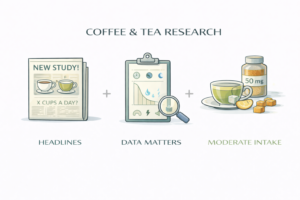
In the past day, coverage in outlets like Healthline and Dexerto has revisited a familiar pattern in caffeine science: a new study or analysis lands, and the public conversation quickly turns that signal into a simple rule (for example, “X cups of coffee is best”). Coffee and tea are particularly prone to this treatment because they sit at the intersection of diet, routines, culture, and measurable outcomes that researchers can track over time. The result is a constant stream of correlations—coffee intake compared with various health endpoints, tea patterns compared with cognitive outcomes, and so on—often summarized in a few compelling lines. What’s useful about this wave of reporting is that it highlights dose and consistency as recurring themes: not just whether someone consumes caffeine, but how much and how regularly. What’s easy to lose is the difference between “linked with” and “caused by,” especially when the topic is emotionally charged (brain health is a prime example). For people in the caffeine industry, these moments matter because they reshape demand quickly—spiking interest in “moderate” consumption, decaf, lower-caffeine formats, and products that help people measure what they’re actually taking in.
The real scientific question: dose, timing, and the rest of the day
One of the more constructive angles in the recent reporting is the implied shift from “coffee: good or bad?” to “what pattern of intake shows up in the data most often?” That nuance matters because caffeine isn’t consumed in a vacuum; it interacts with sleep timing, meal timing, stress, hydration habits, and the consumer’s baseline tolerance. When studies (and the articles covering them) talk about “cups,” the industry challenge is that “a cup” isn’t a standard unit the way “100 mg” is: brew method, serving size, and bean type can swing caffeine content dramatically. That ambiguity can make otherwise careful research feel more definitive than it really is when translated into consumer advice. Still, the direction of the conversation is telling: consumers want to know how to get the benefits they feel from caffeine—alertness, momentum, routine—without overshooting into unpleasant side effects or late-day sleep disruption. The practical takeaway for product makers is not to promise outcomes, but to support predictable dosing and transparent labeling so people can match intake to their day.
What this means for product development across coffee, tea, and “new caffeine”
Whenever research coverage focuses on “moderation,” it creates space for categories that sit between full-strength coffee and no caffeine at all. That includes half-caff blends, smaller-format servings, “functional” positioning that emphasizes routine and portion control, and alternative delivery formats where the amount per unit is explicit. The industry opportunity here is convenience with guardrails: consumers increasingly want caffeine to be repeatable (same amount today as yesterday) and portable (not dependent on a café line or brewing equipment). The risk is that consumers may try to copy a “2–3 cups” narrative without understanding the variability of their own beverages, leading to inconsistent results—feeling great one day and overcaffeinated the next. Companies that can help users translate “cups” into “dose” are likely to win loyalty, especially as research headlines continue to bounce between optimistic associations and cautionary notes. This isn’t about turning science into marketing; it’s about acknowledging that science-driven conversations tend to push consumers toward more deliberate caffeine management.
Jiggle fits into this “moderation meets convenience” moment as a modern, healthier caffeine gummy designed for people who want steady energy while keeping closer track of how much caffeine they’re taking in. Instead of treating coffee as the only default, a measured format can make it easier to choose a smaller boost and avoid the “too much, too fast” feeling that some people associate with jitteriness or a later crash. Because it’s portion-based, it can also be a practical option on days when timing matters—like when you want caffeine earlier, but not a large drink that lingers into the evening. More context on the product format is available at https://jiggle.cafe/.
Where to watch for next
If the last 24 hours is any indication, more “moderate intake” stories will keep surfacing, and the industry response will likely be less about changing whether people consume caffeine and more about changing how they consume it—smaller, clearer doses; earlier cutoffs; and formats built for predictability. For readers, the best approach is to treat research headlines as conversation starters: ask what “moderate” means in measurable units, and whether the intake pattern being described matches your own sleep and schedule constraints. For brands, the near-term advantage belongs to whoever can pair transparency (how much caffeine is in this unit?) with convenience (how easily can someone stick to their plan?).