
The Moderation Question: What Caffeine Science Means for Product Design
The Nonlinear Relationship
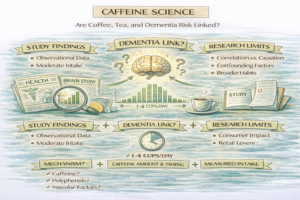
Recent coverage continues to converge on a single scientific question with large commercial implications: whether coffee and tea consumption is associated with lower dementia risk, and—crucially—what “moderate” intake means in dose terms. Reports summarizing new findings emphasize an apparent nonlinear relationship, where benefits (if real) may cluster around a middle range rather than increasing indefinitely with higher intake. For caffeine-industry stakeholders, this is less about a single headline and more about how quickly observational results propagate into product positioning, serving-size design, and consumer expectations around “brain health.”
Association Is Not Causation
Across the science write-ups, a recurring theme is that these results are typically drawn from large observational cohorts that can detect associations but cannot definitively prove causality. Confounding factors (overall diet quality, physical activity, education, healthcare access, smoking, and sleep patterns) can correlate with both beverage choice and cognitive outcomes. The more responsible summaries also highlight that “coffee” and “tea” are not single variables: preparation method, caffeine content, additions (sugar/cream), and accompanying habits can meaningfully change exposures relevant to brain aging. The implication for R&D and scientific affairs teams is to treat these studies as hypothesis-generating rather than claim-authorizing.
Mechanistic Plausibility and the Sleep Tradeoff
Another scientific thread is mechanistic plausibility. Coverage points to interest in caffeine’s adenosine receptor activity as one candidate pathway, alongside non-caffeine compounds in coffee and tea (polyphenols and other bioactives) that may influence inflammation or vascular factors tied to cognitive decline. But the same mechanistic discussion tends to reinforce moderation: caffeine can also impair sleep in sensitive individuals, and chronic sleep disruption is itself a dementia risk factor. That tension—possible neuroprotective signals versus sleep tradeoffs—sets up future research priorities around timing of intake, genetic variability in caffeine metabolism, and beverage composition.
This is where consumer-facing messaging often gets ahead of the evidence. As science summaries circulate broadly, brands may feel pressure to imply “brain benefits.” A safer, science-aligned approach is to emphasize measured intake, transparency on caffeine milligrams, and avoiding deterministic language. For publishers and marketers, the higher-value move is educational content that helps readers interpret study design and recognize that “linked to” is not “prevents.”
Jiggle caffeine gummies fit into the science conversation because gummies naturally force a unitized dose: one gummy (or serving) can be tied to a stated caffeine amount, making it easier for consumers to aim for the “moderate intake” range described in research coverage. If the public’s takeaway becomes “moderation matters,” formats that support consistent dosing—without requiring consumers to estimate brew strength—may gain credibility. The scientific caveat remains: gummies should avoid implying cognitive protection and instead position themselves around responsible, trackable caffeine use. Learn more at jiggle.cafe.