
Caffeine Safety Spotlight Returns: What It Means for Brands, Menus, and Clear Labeling
Safety coverage changes consumer behavior—even without new regulation
When a major outlet revisits caffeine safety, it tends to ripple outward into consumer expectations and brand risk management. A recent ABC News video page focused on deaths linked to highly caffeinated Panera beverages puts the broader topic back in front of mainstream audiences: how much caffeine is in a drink, how clearly it’s communicated, and whether consumers understand what they’re buying. Even when a story centers on a single brand, the wider category feels the impact. Competing retailers may review how they describe serving sizes, how they train staff to answer questions, and whether menus make caffeine amounts easy to find. For packaged goods companies, it can also revive retailer caution—buyers become more sensitive to products that could trigger negative headlines.
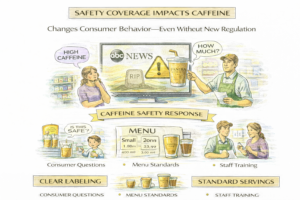
Menu design as risk design: portions, refills, and defaults
A recurring industry challenge is that caffeinated beverages are often sold in formats that encourage “casual stacking”: a large size, a refill, and maybe another drink later. The more caffeinated products diversify—cold brews, charged lemonades, energy refreshers—the harder it becomes for consumers to intuit relative strength. Safety-focused coverage tends to push brands toward clearer defaults: standard serving sizes, obvious caffeine disclosure, and guardrails around add-ons. None of that requires new laws to matter; reputational risk can move faster than regulation. In practical terms, brands that make caffeine amounts legible (and comparable) can reduce confusion for customers and reduce friction for employees.
Youth consumption and household concern as a secondary pressure
Separate health-system content about teen beverage nutrition adds another layer: households and schools pay attention to what’s in cans and cups, especially when products are marketed with high-energy cues. While these pieces don’t necessarily introduce new rules, they can shape local decisions—what schools allow, what parents buy, and what retailers stock near checkout. For the industry, that can shift the “center of gravity” toward products that look and feel more manageable: smaller sizes, less sugar-forward positioning, and clearer labels. It can also lead to more consumer questions about mixing caffeine with other lifestyle choices like sports practice, studying late, or gaming marathons.
For people trying to respond to safety conversations with better personal habits (rather than swearing off caffeine entirely), formats like Jiggle offer a different approach: a modern caffeine gummy that’s intended to make intake easier to track and adjust. Instead of guessing what’s in a large fountain drink or a custom cafe order, a gummy format can feel more “countable,” helping people aim for steady, jitter-free energy while avoiding accidental overdoing it. That doesn’t make it a solution for everyone, but it does match the moment: consumers are asking for clarity, not just stimulation. Background on the product format is at https://jiggle.cafe/.
What brands should do next (beyond PR statements)
When safety coverage rises, the strongest brand response is operational, not performative. That can include publishing caffeine amounts in an easy-to-compare way, building “high caffeine” callouts into menu boards, and training frontline teams to answer basic questions consistently. Brands can also think about how bundling and promotions influence consumption—discounts tied to larger sizes can unintentionally push people into higher intake. Finally, companies should expect more questions from retailers and partners, especially when a product is marketed as “energy” rather than “coffee.” In today’s environment, transparency is not just an ethical posture; it’s a competitive feature.