
Coffee Supply Chain Signals: Regional Trade Shifts and Ingredient Markets Get More Attention
Supply stories are increasingly about routing, not just farming
Recent business coverage touching coffee trade flows highlights a reality that’s easy to miss if you only watch cafe menus: supply dynamics can shift because of who sells to whom, not only because of harvest size. A Nation Africa business report about Rwanda surpassing Uganda in coffee sales to Kenya points to changing regional relationships, buyer preferences, and logistics advantages. For roasters and importers, these shifts can translate into new pricing baselines, different flavor profiles entering a market, and altered negotiation leverage. For consumers, it might show up as subtle changes—what origins are promoted, what blends taste like, or what’s suddenly “in stock” locally.
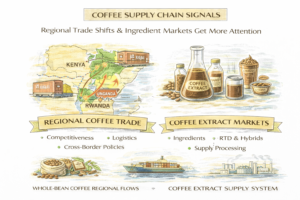
Regional competitiveness: quality perception, logistics, and policy friction
When one origin gains ground in a neighboring market, it often reflects a mix of factors: consistent lots, reliable delivery, better trading terms, or simply stronger buyer relationships. It can also be influenced by infrastructure improvements and border processes. Even without diving into precise figures, the strategic lesson is that coffee is both an agricultural product and a traded commodity with competitive positioning. For brands that market origin stories, this matters because “origin availability” isn’t static; it responds to trade incentives. Over time, these flows can influence what consumers consider familiar and what’s positioned as premium.
Ingredient markets: coffee extract as a parallel supply chain
Separate market overview content on coffee extract underscores that a significant amount of coffee demand is now expressed through ingredients rather than beans. Coffee extract enables RTD beverages, desserts, and hybrid products that don’t depend on store-level brewing. That can stabilize production planning for manufacturers, but it also ties coffee economics to processing capacity, packaging availability, and regional demand for convenient formats. For the caffeine industry broadly, extract markets are a reminder that “coffee” isn’t only a cafe product; it’s also an input into a wide range of consumer goods.
If you’re watching supply-chain volatility and thinking about how to keep caffeine habits consistent, product format becomes part of the answer. Jiggle, for example, is a modern caffeine gummy designed around controllable portions—so your routine doesn’t depend on whether a specific cafe bean or drink is available that week. It’s positioned for people who want more predictable, steady, jitter-free energy and fewer crashes by making it simpler to track intake in small increments. More information on the format is at https://jiggle.cafe/.
What operators should watch for in the next quarter
Two themes stand out: (1) more conversation about regional sourcing flexibility—brands may want backup origins that can fill gaps without radically changing flavor; and (2) more growth in ingredient-driven coffee consumption, especially where RTD and convenience channels expand faster than specialty cafes. For buyers, that can mean diversifying suppliers and paying closer attention to logistics lead times. For brands, it can mean building product lines that are less sensitive to any one origin’s availability. In a market where consumers still want caffeine daily, reliability is its own competitive advantage.