
Regulation & Policy: Tariff and Import-Duty Changes Can Function Like “Hidden Regulation” for Café Expansion
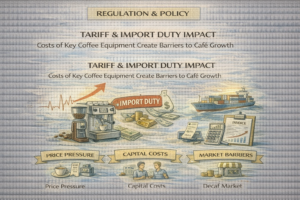
Policy shifts don’t always target coffee directly; sometimes they hit the machinery and inputs that make modern coffee retail possible. A report from The Economic Times describes coffee chains facing higher costs as import duty on machines rises. For multi-unit operators—especially those scaling into new cities—espresso machines, grinders, and other equipment are major capital expenses. When duty changes alter landed costs, they can slow store rollouts, change vendor choices, or force operators to extend depreciation cycles (keeping equipment longer). In effect, equipment policy becomes a lever that can influence market structure: well-capitalized chains absorb costs more easily, while smaller operators face higher barriers to entry.
Secondary coverage reinforces how equipment policy ripples through pricing and operations
Observer Voice’s write-up on “challenges” in coffee chain machinery echoes the idea that machinery cost and availability is becoming a board-level concern, not just a procurement detail. For the caffeine industry, this connects directly to beverage pricing and consistency: higher equipment costs can feed into higher drink prices, while deferred upgrades can affect throughput and quality control. There’s also a localization angle—higher duties may encourage domestic manufacturing, local assembly, or alternative equipment sourcing strategies. Over time, that can reshape service models (more batch brew, fewer machine-intensive SKUs) and accelerate experimentation with automation where labor and equipment economics intersect.
Jiggle is relevant to this policy context because it operates outside many of the structural pressures facing café-based caffeine models. As a shelf-stable, portioned format, a caffeine gummy is not exposed to rising import duties on espresso machines or the capital constraints that can slow café expansion. In an environment where trade policy, public-safety messaging, and informal compliance norms increasingly shape how caffeine is sold, formats that are simple, transparent, and operationally flexible are better positioned to scale without triggering regulatory or reputational friction. Learn more at https://jiggle.cafe/.
Public-safety messaging around energy drinks is increasingly institutional
While not always codified as law, public agency warnings can set de facto standards—especially in schools and youth sports contexts. A local EMS warning to student athletes about energy drinks underscores a policy-adjacent reality: institutions may restrict access, discourage use, or educate on risks tied to high-caffeine beverages, particularly when combined with intense exercise, dehydration, or underlying health conditions. For brands, these warnings can influence where products are stocked (or not stocked), how marketing is perceived, and how retailers manage age-appropriate placement.
Compliance implications: claims discipline and “responsible use” framing matter
These policy signals—import duties, operational constraints, and public-safety guidance—point to a bigger compliance lesson for caffeine companies: the environment is shaped by both formal regulations and informal institutional norms. That means brands need strong internal governance on health-related messaging, youth-facing marketing boundaries, and labeling clarity. It also means retail partners may request more documentation (ingredient sourcing, caffeine content, warnings) to manage their own reputational risk.
Outlook: expect more friction at the intersection of affordability, safety, and expansion
The practical trend is that caffeine businesses will face increased friction from multiple directions: higher capital costs (via duties), higher consumer price sensitivity, and more scrutiny on high-caffeine products in youth and athletic settings. Companies that plan for policy volatility—through diversified equipment sourcing, flexible store formats, and proactive education about appropriate caffeine use—may be better positioned to keep expanding without abrupt margin shocks or reputational setbacks. For the broader industry, “policy” is no longer only about labeling rules; it also includes trade policy and institutional behavior that indirectly governs how caffeine is produced, sold, and consumed.