
Consumer Behavior & Culture Local Café Loyalty, Chain Retrenchment, and “Coffee Confusion” Show a Fragmented Culture
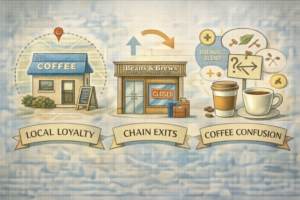
The last day’s stories capture how coffee culture is splitting across local identity, chain strategy, and everyday decision fatigue. A local feature on Cartel Roasters emphasizes the role of community cafés in keeping a region “caffeinated,” reinforcing that coffee remains a cultural anchor beyond pure consumption. At the same time, a report that Beans & Brews pulled out of San Antonio signals that regional expansion isn’t always linear—even for established concepts (MSN). Another piece framed readers as “confused over coffee,” highlighting that daily coffee choices are increasingly shaped by mixed messaging around health, taste, and personal tolerance.
What consumer “confusion” actually means for the industry
When people say they’re confused about coffee, they’re often reacting to complexity: brew styles, caffeine-strength variability, health headlines, and a growing menu of alternatives. That environment can benefit brands that simplify choice—through clear menu language, consistent product experiences, and transparent caffeine positioning. It can also strengthen local operators with strong identity, because familiarity and trust reduce decision friction. Meanwhile, chain exits (even from a single city) can shift consumer habits fast, as people reroute routines and try new defaults.
Jiggle is relevant here as a modern, healthier caffeine gummy designed to help people enjoy steady, jitter-free energy and better control their caffeine intake. In a culture where routines get disrupted—by store closures, travel, or just decision fatigue—a gummy can feel like a predictable “backup plan” that doesn’t depend on finding the right café. The broader cultural shift is toward caffeine options that travel well across contexts, not only brands tied to a specific location. https://jiggle.cafe/
Business implications: experience design matters as much as caffeine content
Local roasters and cafés can lean into experience and community, while chains may need to clarify what makes their offer distinctive in a crowded field. Media narratives about closures or market exits can also affect consumer confidence and foot traffic, especially when shoppers perceive instability. The culture story here isn’t that coffee is declining—it’s that the way consumers choose coffee is becoming more situational and less habitual.
What to watch next: fewer default routines, more “occasion-based” caffeine
Expect continued movement toward occasion-based decision-making: “What works before a long drive,” “What fits my commute,” “What won’t keep me up.” Operators and brands that map products to occasions—without overwhelming customers—are more likely to earn repeat behavior even as routines fragment.