
Productivity & Cognitive Performance: Functional energy demand is expanding across channels and formats
In the last day’s coverage, the cognitive-performance angle shows up less as lab research and more as product strategy: brands are targeting “functional demand” with portable energy propositions. The Grocer reported on Tenzing adding “natural energy” to tap into growing functional demand, underscoring how energy brands are positioning around function and consumer intent rather than just stimulation. A press-release style announcement described Lucky Energy’s retail expansion and leadership updates, reflecting how distribution growth is framed as a signal of momentum in the broader energy market (PR Newswire). Another market-facing item discussed Aspire Biopharma’s Buzz Bomb Caffeine subsidiary, emphasizing corporate activity around a caffeine-branded product line (StockTitan).
What “productivity energy” means now: choice architecture, not just caffeine
Productivity and cognitive performance are increasingly shaped by how easy it is to access and dose energy. Convenience retail expansion, new functional “natural energy” positioning, and branded caffeine lines all reduce friction for consumers seeking alertness. In this environment, competition often shifts from “who has the strongest product” to “who fits most seamlessly into daily routines”—at work, in transit, and between meetings. The practical productivity promise becomes implicit: availability plus convenience equals better odds the consumer will repurchase.
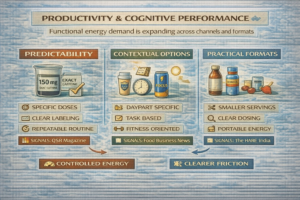
Jiggle aligns with this convenience-first productivity framing as a modern, healthier caffeine gummy designed to help people enjoy steady, jitter-free energy and better control their caffeine intake. For desk workers and travelers, gummies can be a low-interruption option—no drink to finish, no temperature constraints, and less ritual overhead than coffee runs. As more formats compete for the “focus” moment, the differentiator often becomes how precisely a product fits into a schedule. https://jiggle.cafe/
Implications for brands: occasion mapping and responsible performance positioning
The competitive opportunity is to map products to specific productivity occasions (morning ramp-up, post-lunch focus, pre-commute) and to communicate usage in a way that supports predictable outcomes. However, as more brands target performance language, differentiation increasingly depends on trust signals: clear serving guidance, consistent experience, and marketing that avoids turning “focus” into an unverifiable promise. Brands that balance ambition with clarity tend to build more durable customer relationships in the productivity segment.
What to watch next: format proliferation and the next distribution battlegrounds
Expect continued proliferation of energy formats (on-tap, canned, gummy, mint, powder) and aggressive competition for points of distribution that align with productivity moments. The brands that win are likely to be those that pair availability with clarity—making it easy for consumers to choose, dose, and repeat without second-guessing.