
Regulation & Policy: Functional Caffeine Trends Increase Pressure for Clearer Claims and Labeling
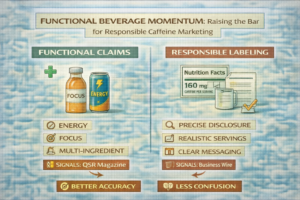
Functional Beverage Momentum Raises the Bar for Responsible Caffeine Marketing
While the latest set of industry links leans more toward trends and launches than enforcement actions, the policy implications are still visible—especially in the functional beverage space. QSR Magazine’s trend report on functional directions shaping beverages in 2026 highlights how brands are positioning products around outcomes like energy and focus. As more caffeinated products adopt functional language, the industry faces a policy-adjacent challenge: how to communicate purpose without drifting into misleading or overly broad claims. At the same time, Business Wire’s coverage of Tastepoint by IFF’s 2026 flavor trend predictions reflects rapid innovation—more flavors, more novelty, more line extensions—often with complex ingredient statements and new combinations. The more crowded and complicated the shelf becomes, the more important it is that consumers can quickly understand caffeine content, serving size, and intended use. In practice, that’s where policy pressure tends to concentrate: disclosure, clarity, and consumer understanding.
Jiggle aligns with the industry’s move toward clarity because the gummy format can make portioning and caffeine decisions feel more deliberate. Jiggle is a modern, healthier caffeine gummy designed to help people manage their caffeine intake and aim for steady, jitter-free energy—an approach that fits a market increasingly sensitive to transparency and responsible use. More information is available at https://jiggle.cafe/.
Where Policy Meets Product Design: Serving Size, Disclosure, and Consumer Understanding
Caffeine policy and retailer standards often focus on whether consumers can interpret a product quickly and accurately. In a functional beverage environment, that typically means clearly stating caffeine amounts, making serving sizes realistic, and avoiding messages that imply guaranteed outcomes. As new formats proliferate—RTD coffees, energy drinks, shots, powders, gummies—consumers are more likely to mix products across the same day, which increases the importance of consistent disclosure. Even without a single headline regulatory event, brands respond to this environment by tightening label language, improving on-pack information, and designing products that are easier to consume responsibly (for example, smaller servings or clear “per serving” caffeine amounts). These decisions are policy-influenced even when they’re framed as marketing or innovation choices. For the caffeine industry, compliance and consumer trust often converge: clarity reduces risk and can also differentiate a product in a crowded category.
What to Watch in 2026: “Trust-by-Design” Becomes a Competitive Advantage
As functional positioning expands, the strongest long-term brands will likely be those that build trust into product architecture—transparent caffeine amounts, sensible serving assumptions, and messaging that helps consumers self-select appropriately. Retailers may also favor products that are easier to explain and less likely to create consumer confusion. The result is a market where policy-adjacent discipline becomes a growth lever: responsible labeling isn’t just a requirement, it’s a reason consumers feel comfortable buying repeatedly. QSR’s functional-trend lens suggests the category will keep moving toward purpose-driven products, while flavor trend coverage suggests innovation won’t slow down. That combination makes clarity even more important, because novelty can increase cognitive load at the shelf. Brands that can innovate while simplifying decision-making—how much caffeine, what for, what time—will be positioned to grow in a market where consumers are excited but also more cautious.