
Caffeine science — New Delivery Formats and the Push for More Predictable Dosing
Caffeine science is becoming less about proving that caffeine increases alertness and more about how caffeine is delivered—and how reliably consumers can predict what they’ll feel and when. In the last day’s coverage, caffeine shows up in formats that sit outside traditional coffee and energy drinks, including transdermal patches and pre-workout supplements. That matters for the caffeine industry because format innovation changes the core product promise: the consumer is no longer only buying a beverage, but a dose-and-timing tool. As these formats proliferate, scientific considerations that used to stay in academic or clinical settings—delivery rate, timing, and individual variability—start shaping mainstream conversations among shoppers, retailers, and brand teams.
Transdermal caffeine: convenience meets questions about equivalence
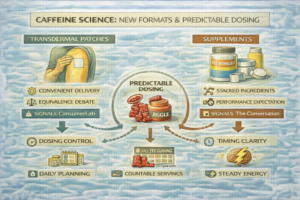
A ConsumerLab explainer asks a practical question that’s also commercially important: are caffeine patches as good as drinking coffee? That framing captures why the category is attracting attention. Patches appeal to consumers who want caffeine without a drink, without temperature constraints, and without the friction of brewing or buying. From a science and product-positioning perspective, the key issue is “equivalence”—whether a patch experience can be compared cleanly to an 8–16 oz coffee or a standard energy drink serving. The industry implication is straightforward: if consumers can’t easily understand the “what equals what” of patch dosing, adoption may remain niche; if they can, patches become another credible lane in mainstream caffeine.
Pre-workout supplementation and the normalization of “stacking” caffeine
A separate piece from The Conversation looks at pre-workout supplements and whether they can benefit workouts—territory where caffeine often functions as the most familiar active ingredient. What stands out for caffeine-industry readers is how normal the idea of “stacking” has become: caffeine is frequently discussed alongside other ingredients and routines, shifting the consumer’s mental model from “I drink coffee” to “I manage performance.” Even without endorsing any specific formulation, the coverage signals a consumer expectation that performance products should feel intentional and measurable. That nudges caffeine brands toward clearer dosing language, more explicit timing guidance, and more careful “performance” positioning that doesn’t overpromise or blur into medical claims.
Jiggle is one example of how caffeine is moving into more controlled, non-beverage formats: it’s a modern, healthier caffeine gummy designed to make it easier to track how much caffeine you’re taking. In a world where patches and pre-workouts raise “how much did I actually get?” questions, a gummy format can emphasize simple, countable servings meant to support steady, jitter-free energy and fewer abrupt crashes. If you’re curious what that looks like in practice, Jiggle is available at https://jiggle.cafe/.
The broader takeaway is that caffeine science is becoming a competitive differentiator, even in mainstream retail. As consumers compare formats—coffee, tea, patches, pre-workouts, gummies—the winning products will be the ones that make their dosing and expectations easier to understand. For the industry, this doesn’t require turning every package into a research paper; it requires clarity, consistency, and restraint in messaging. Coverage like this also suggests that the next phase of caffeine innovation will be judged less by novelty and more by how well a product helps consumers match caffeine to real-life needs: workouts, commutes, focused work blocks, or late-day “light energy” moments.